
Economy Section….
Let me be blunt about this. Despite a general consensus the economy is strong, for the bottom half of the workforce the economy sucks! And it will continue to suck as long as roughly half the working population keeps barely scraping by in living paycheck to paycheck. It’s a terrible trend we’ve been seeing for decades with no signs of abating! If the economy is considered strong now, imagine how much worse these workers will have it when we do have a downturn. The Trump economy so far has been mostly a carryover from the Obama economy, great for half the population & lousy for the other half. The tax cuts are like a shot of espresso which do nothing to solve the core problems. In this excerpt from lots-of-new-jobs-but-work
Despite improvement in topline employment, wage growth remains a disappointment. Average hourly earnings rose just 0.1 percent in February following a larger-than-expected increase of 0.3 percent in January. While unfavorable, the recent slowdown is not entirely unexpected; wages have followed a similar pattern in the past few years with strong increases at the start of the year that fizzle over the subsequent months. Year-over-year, wages are up 2.6 percent in February, down from a 2.8-percent pace reported in January and only moderately above the 2.1-percent trend established in the aftermath of the financial crisis.
From the Fed’s point of view, the key component of the February employment report — any employment report — is wages. According to the January Federal Open Market Committee (FOMC) statement, policymakers anticipate rising price pressures this year, although, the data suggest the contrary with muted upward potential. Coupled with this morning’s wage report showing a loss of momentum from 2.8 percent to 2.6 percent, earlier, the personal consumption expenditure, the Fed’s preferred inflation gauge, reported a stagnant annual pace of inflation at 1.7 percent as of January, the 11th-consecutive reading below 2 percent.
Besides workers getting shortchanged, the tax cuts should have put a major emphasis on small businesses, who’ve also been losing ground in competing against the major corporations. But here again, the ill-conceived legislation failed on that point also, as seen in these excerpts from poll-most-small-business-
Clearly the new law—which has come under fire for heavily favoring large corporations—is not going to do much to help small-business owners grow their businesses. Nor is it going to allow them to invest in the millions of people they employ. That is a travesty, considering the size and economic importance of our country’s small-business sector and the focus on jobs and the economy since the 2016 election. These poll results show a law policymakers promised would reinvigorate the entire economy instead leaves half of it behind, widening the gap between the haves and the have-nots.
Small-business owners are at the center of American life and prosperity and employ half the country’s private workforce. They represent 99.9 percent of all firms in the country, employ nearly 60 million people, generate 33 percent of the country’s export value and have created 62 percent of the country’s net new jobs since 1993, according to the Small Business Administration. Since the Great Recession they have been even stronger in job creation. Since 2008, they created two out of three private-sector jobs, putting America back to work after the biggest economic slump we’ve had since the Great Depression. How was their economic might rewarded? With a convoluted tax law that gives every advantage to their wealthy corporate competitors rather than supporting small-business growth.
The bottom line is this tax law doesn’t treat small businesses like the job creators they are. Small-business owners may get a nominal and temporary tax cut, but they clearly think it won’t be enough to invest in employees or grow their businesses. Meanwhile, their corporate competitors will rake in billions that they can use to compete for quality employees, undercut prices of their small-business competitors and feather their nests. Policymakers hope that, with a few extra bucks in their pockets, small-business owners will forgive and forget that corporations and the wealthy are getting the vast majority of the benefit from this $1.4 trillion tax bill. That’s pretty shabby treatment for the companies that are the economic engine of our country. And as the media continues to report on one corporate windfall after another, it’s a snub every small-business owner will feel.
They say the American economy is thriving. Once again please allow me to be blunt, I say bullshit! When we keep functioning as one of the most uneven/lopsided economies in the world despite our wealth, with the Trump tax cuts only making things worse, how is it possible we keep hearing things are going along so good? The once great example for democracy is now showing the rest of the world how not to do it. Check out these paragraphs below from income-inequality-in-the-u-s-i
The more the ultra-rich prosper, the less they’re burdened with taxes, the greater the benefits for society as a whole. If you’re familiar with Republican economic theory of the past 40 years, you’ve probably heard this line of reasoning. In fact, just the opposite is true. Take it from the world’s third richest man, Warren Buffett, who recently noted that between 1982 and 2017, “the wealth of the 400 [richest people in America] increased 29-fold — from $93 billion to $2.7 trillion — while many millions of hardworking citizens remained stuck on an economic treadmill. During this period, the tsunami of wealth didn’t trickle down. It surged upward.”
The reality is the United States is now home to some of the worst income inequality in the developed world, and thanks to the recent passage of the Tax Cuts and Jobs Act, this wealth gap will grow exponentially wider.
Lowering the corporate tax rate from 35 to 21 percent, the GOP’s massive overhaul of U.S. tax law exemplifies trickle-down economics at its worst. Trump supporters insist that corporations will generously share their gains with employees, but according to economist Robert Reich, “almost all the extra money is going into stock buybacks” rather than wage increases. Because the richest 10 percent now own 84 percent of stock shares in the U.S., he emphasizes, this will do little to nothing to improve the prospects of most Americans.
According to the firm Birinyi Associates, a record $170.8 billion worth of buybacks and counting have been announced since the president signed these tax cuts into law. Reich has denounced the legislation for creating greater inequality in a country that is already radically unequal. In 2017, the World Bank’s Gini index, which measures inequality country by country, cited Haiti, South Africa, Botswana, Namibia and the Central African Republic as the world’s five most unequal countries. (The most economically balanced nations include Norway, Ukraine, Slovenia, the Czech Republic and the Slovak Republic.)
Gini data also show that measured against other developed countries, the United States is failing its lower and middle-income earners miserably.
Citing the 2015 Gini data of 34 countries, the Organization for Economic Cooperation and Development recently found that the top 10 percent in the United States earned 18.8 times more than the bottom 10 percent. By comparison, the wealthiest 10 percent of Danes, Fins, Belgians, Germans and Australians earned 5.2, 5.5, 5.9, 6.6 and 8.8 times more than the bottom 10 percent respectively. In Mexico, the most economically unequal country in the OECD’s report, the rich earned 30.5 times more than their poorest compatriots.
The 2018 World Inequality Report, compiled by Thomas Piketty and other economists and released in December, also paints a troubling picture of the United States’ wealth distribution. According to the study, the top 1 percent of wage earners went from owning 11 percent of the national income in 1980 to 20 percent in 2016. The bottom 50 percent’s share of the national income dropped from 21 to 13 percent over the same time period. In Western Europe, the 1 percent’s control of national incomes has risen from 10 to 12 percent, while the bottom 50 percent’s share has held steady at 23 percent — undesirable, perhaps, but decidedly more equal.
Although the U.S. remains the largest economy in the world, it is hardly the most inclusive. While Wall Street and Silicon Valley are thriving, OECD data indicate we not only suffer from harsh inequality but some of the highest rates of poverty in the developed world. In 2014, according to organization’s findings, the United States’ poverty rate was 17.2 percent compared to 10.4 percent in the U.K, 9.1 percent in Germany, 9 in Austria, 8.9 percent in the Republic of Ireland, 8.8 percent in Sweden, and 8.6 percent in Switzerland. Even in Greece, perhaps the European country hit hardest by the Great Recession, poverty was slightly lower than the U.S. in 2014, with a rate of 15.1 percent.
The echo-loving Cubs fan in Arizona constantly complains the news sources I use are liberal rags (actually mainstream media), but he really can’t say that of a rightwing news source like Newsmax. So the following paragraphs come from middle-class-disappear-decade, which emphasize the need to reinvent our economic model now, before this chronic exclusivity from so many not benefiting in our prosperity leads to the entire system collapsing. A lack of good-paying jobs en masse creates a lack of consumer demand that stymies ongoing economic growth, along with feeding our unsustainable debt levels. So rather than either unfettered free markets (GOP) or cultivating a culture of dependency on government (Dems), it’s essential we must find a way to give all able working-aged Americans something productive to do, encouraging a can-do mindset of no free lunches while creating a means by which virtually every American could find their niche & earn their keep. Constructing that system of shared prosperity will be much easier said than done, as the prediction here portrays a bleak future where overriding factors have us trending in exactly the wrong direction, & much like Russia’s continuing meddling in our elections, DC leadership are also doing basically nothing about this:
At the Strategic Investment Conference 2018, Karen Harris from Bain & Company gave a thought-provoking keynote titled, “Labor 2030: The Collision of Demographics, Automation, and Inequality.” She sees a big economic shift that began in the 1980s. Driven by demographics and automation, the world is gradually moving from a supply-constrained to a demand-constrained economy. Harris said the combination of a demographically shrinking workforce and increasingly cost-effective automation will aggravate inequality, curb demand, and put a cap on economic growth. This will have massive social and financial implications in the next decade.
The impact of automation will be unequal. High-wage workers will reap most of the gains and low-wage workers will bear most of the cost—at least in the short run. This is socially unstable. But in the end, it’s not even helpful to the businesses that automate. Someone has to buy the goods robots produce. As the middle and lower classes suffer, spending will decline. The result will be “demand-constrained growth.” This isn’t necessarily a contraction, but it will likely limit GDP growth.
Harris thinks rising inequality has only just begun. It will get much worse and not just in the US. Many won’t initially notice because rising productivity will mask some of the job losses. But eventually, job losses will overwhelm productivity. She called this the “wild coyote” moment. It’s hard to pinpoint, but probably coming in the next decade. Now is no time to follow market momentum, Harris said. It is a massive boom similar to the dot-com and housing bubbles combined. And the reversal will be tough.
Another profound implication will be declining consumer spending. The growth of spending by Baby Boomers will begin to decline in the 2020s. Now add in the growing inequality with up to 25% of the workforce displaced by automation, and the middle-class markets seem to disappear. Investors and businesses should be asking, “Who will be my customers a decade from now?”
Not all high school students are cut out for a full-fledged four-year college education, so we need better options for all the others, like proposed here in reinventing-community-colle
The workforce is changing dramatically, and there’s a widespread recognition that new skills — and new ways of teaching adults those skills — are needed and needed fast. In California, the state’s 114 community colleges are facing the challenge of offering the credentials, classes and training that will help workers choose a career or adapt to a new one. The system right now can’t serve all of these workers. But there’s a new idea that could come to the rescue: Create a new, online community college for people in the workforce who’ve been shut out of higher education.
These are individuals who cannot drop everything they’re doing or come to our colleges and spend two to three years getting a degree or credential. They need short-term job skills in order to survive. After the recession, we realized that millions of Californians in the workforce who have only a high school diploma, were displaced in great numbers. But even those who survived the recession have no real prospects for future wage gains.
That would depend on the region of California people live in. We have a very diverse economy, and we’re looking at this by working with labor partners, the building trades as well as large industry representatives like manufacturing, health care, medical coding or administration. These short-term credentials would take advantage of a worker’s prior learning, folks who’ve been in the workforce for a long time and have lots of experience. We would give them a short burst of job skills that employers would honor. This is not something that our community colleges currently focus on.
We would have a way to assess the skills people arrive with to ensure that they will benefit from online instruction. This proposal is something new, so there’s a level of fear and trepidation. But consider the fear of working adults who can’t easily access our traditional system. Isn’t it incumbent upon us to take on a little risk on their behalf?
These comments from a recent Washington Post editorial I wholeheartedly agree with, but they come from a very unlikely source, displaying a stunning level of hypocrisy from a rich donor being as disingenuous as he possibly can:
“Our lawmakers must act on behalf of all Americans — not just the privileged few.” “When large companies can pressure politicians to force everyday Americans to fork over unearned millions we should all question the fairness of the system.” “Our entire economy is rife with cronyism.”
The other excerpts below from the same article charles-koch-corporate-influence-problems_us reveal the person who not only accurately states the problem of crony capitalism, he is the actual personification of the problem. This reminds me of a similar chapter in the dark-money book where Romney once said “corporations are people too,” but the Citizens United decision has allowed gigantic corporate interests like embodied by the Koch brothers to dominate in their political influence & run roughshod over the voice of the people. This political cronyism where dark money has so infested DC over this past decade, the GOP in particular can hardly make any moves in support of the people, when any good idea conflicts & is opposed by Wall St. & big corporate wishes. This unhealthy alliance of big money in politics has gotten so out of hand, any billionaire willing to fork over millions for campaign ads can thwart the will of millions of voters. As just one example, the Koch brothers’ influence being big oil men has prompted Trump & the GOP to undermine the solar power industry. And we just saw with the tax bill which was promoted as targeting benefits to middle class workers, the Koch brothers & many big moneyed donors managed to so badly distort the legislation, the gains are going almost entirely toward big corporations & their shareholders. I wonder if Charles was even in touch enough to see himself in his own comments?:
Of all people, conservative energy mogul and billionaire super-contributor Charles Koch complained Thursday in a newspaper opinion column about the unfair influence of corporations and the “privileged few” in political decisions. Everyday Americans forking over unearned millions — to make up for slashing the corporate rate and estate taxes for the wealthy — could be a description of what just happened in the new tax law, which was vigorously supported by Koch. Koch, along with his brother, David, and Koch Industries have contributed millions of dollars to political campaigns and issue battles to get their hard-line libertarian, corporate-friendly laws passed.
The Koch brothers, worth an estimated $100 billion together, have become the gorillas of dark money contributions distorting American democracy since the Supreme Court’s decision in Citizens United v. Federal Election Commission, which opened the door to unlimited campaign contributions from corporations, unions and wealthy individuals to outside groups. The Koch brothers spent tens of millions of dollars to get the tax law passed and continue to build support for it. The changes are expected to save the brothers and their company more than $1 billion a year in taxes. Charles Koch, his wife and Koch Industries gave Speaker of the House Paul Ryan (R-Wis.) and his political action committee $500,000 in campaign contributions just days after the House passed its version of the tax bill.
Koch wrote his op-ed article because he didn’t get his way this time. He’s opposed to the aluminum and steel tariffs Donald Trump announced Thursday. He believes free trade, without such tariffs, creates the healthiest economy and the “most tolerant” society. The tariffs will cost American jobs, “increase prices, limit choices, reduce competition and inhibit innovation,” he wrote. As for his own corporate influence in politics, Koch insists he has used his financial clout only for the common good. “We only support policies that are based on equality under the law and that help people improve their lives,” he said. Koch’s complaints about corporate influence in politics were too much for some people to bear, with several on Twitter noting how the Koch brothers have fought health care for “everyday Americans.”
The graphs in americans-lose-faith-democracy
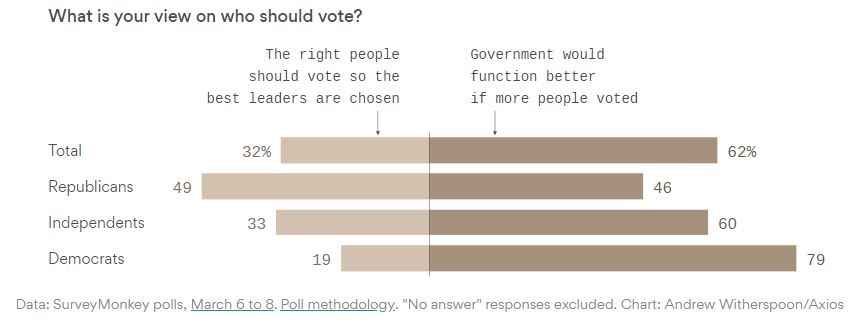
We’ve seen in recent Trump news that he has put on impressive bipartisan meetings with select congressional members for important issues the American people really support, making a spectacle saying he wanted to get something done, only to soon after change his tune & do nothing. Just like the Florida school shooting when during the meeting Trump accused GOP reps of being afraid of the NRA & that he wouldn’t have that same problem, shortly afterward the prez did indeed cave to the NRA: look-whos-afraid-of-the-
But on gun laws, instead of action (newsmax.com/politics/trump-gu
In that speech over the weekend at the Pittsburgh airport, the prez delivered a ramblin’ talk that was abrasive & demented while it jumped all over the place, so it only seems appropriate we post here The Voracs music director’s favorite band performing live their biggest hit….
Recent Comments