

Job Guarantee, Tax Cuts, Midterm Projections….
Is the job guarantee floated by liberals a good idea? See below for analysis, but first let’s examine the tax cuts & their effects on the economy. It was sold by Trump & his party as a massive tax cut benefiting the middle class. The part they got right is indeed, it is massive: trump-gop-tax-law-sp-500-compa
It’s no coincidence that the biggest proponents of the Trumpian economic approach are in their 70s — and/or hail from the big Wall Street banks. A fossilized economic outlook, combined with economic self-interest, gives us a huge deficit, yawning income inequality and very mild growth. Instead of a party selling a weird mix of anti-immigrant hysteria, protectionism and big tax cuts for the rich, Pethokoukis asks us to imagine a “modernized Republican party which understood that automation, not the weakening China trade shock, is the biggest threat to jobs. It would spend as much time fashioning serious education and work-support policies as it currently does pushing tax-cuts for the rich. A reformed party would seek to attract more foreign workers and entrepreneurs with a good chance of succeeding in an economy on the technological frontier.” He adds, “Perhaps most importantly, it would seek to accelerate growth by ensuring that tax, spending and regulatory reforms promote a competitive, not crony, capitalism.”
Republican lobbyists, donors and creaky advocacy groups that hand out demerits whenever lawmakers deviate from decades-old economic dogma don’t recognize Pethokoukis’s economic formula as conservatism. To them, anything but slashing government spending and cutting top marginal tax rates is practically socialism. The problem, as Pethokoukis says, is that the 1950s/1980s version of conservative economics doesn’t do much for an economy with needs and challenges far different from those of the Eisenhower or Reagan years. To boot, what Trump is selling is not politically popular. After the country and the GOP rid themselves of Trump, they need to rid themselves of a stodgy and ineffective economic approach. If the GOP doesn’t, Democrats may beat the party to the punch.
This article donald-trumps-creed-of-greed-product-of-a-society-that-puts-profit-before-people explores the folly of Ayn Rand’s original writings from decades ago, now out of touch with the modern economy from being stuck in their old supply-side dogma, yet the current GOP stays faithful to such obsolete beliefs. This is how the article begins:
If there is one phrase that captures the personal philosophy that has guided Donald Trump throughout his life and presidency thus far, it may well be the infamous words of Gordon Gekko, the villain played by Michael Douglas in Oliver Stone’s classic film “Wall Street”: “Greed is good.” The president has long subscribed to this philosophy of greed, and during his campaign in 2016 he boasted about his own greediness as if it were a virtue: “I like money. I’m very greedy. I’m a greedy person. I shouldn’t tell you that, I’m a greedy — I’ve always been greedy. I love money, right?” It quickly became evident why Trump — who claims to be Christian, even though Christian dogma clearly states greed as one of the seven deadly sins — was bragging about his greed when he went on to declare that he wanted to be “greedy” for America. “I want to be greedy. I want to be so greedy for our country.” This rhetoric was consistent with his campaign pledge to run the United States government as he ran his business, which appealed to many voters who have been hoodwinked into believing that running a country like a for-profit company is the solution to all our problems.
Between college loans & other factors, young people are generally off to slow starts in their careers & lives, as I’ve posted here an excerpt from congratulations-graduates-now-get-ready-to-work-for-free:
One consequence of this wage warfare on college graduates is growing intergenerational inequality. The data reflecting reduced economic opportunity and reduced accumulation of wealth for the young is staggering. Lawrence Yun writes in Forbes that, as of 2013, the wealth difference between the young and the old opened up to over 20-to-1. The net worth of the older generation has risen while that of the younger generation has fallen: $210,500 versus $10,500. His estimate for 2015 was even wider: $250,000 to $10,000. In 2014, for the first time, more 18-34-year-olds lived at home with their parents than in any other arrangement, according to a study by the Pew Research Center. Young people can’t buy homes, can’t afford kids and don’t buy cars. But more importantly, the long-term effects of losing living wages in the early years after graduation are substantial. And the groups that are hit the hardest are those that are already less economically privileged because unpaid and underpaid work exacerbates existing social divisions.
And in these excerpts from more-than-half-of-60-somethings-say-theyre-delaying-retirement, we’re seeing 60-somethings running behind on the end of their careers. The bottom line to many of these Trump news articles related to the economy, that despite our nation creating enormous wealth, the system is rigged by the political & corporate powers-that-be which deny the opportunities/benefits from going to much of the population:
Fifty-three percent of full-time workers in that age group say they are postponing when they’ll stop working, according to the CareerBuilder survey. Two in five workers think they won’t be able to retire until at least age 70. The number of older Americans in the work force has been growing steadily for years. In 1996, less than 46 percent of people age 60 to 64 were working, according to the Bureau of Labor Statistics. By 2016, that number grew to nearly 56 percent. By 2026, it’s expected to reach about 60 percent. Roughly 10,000 baby boomers turn 65 every day. Unlike the generation that came before them, many are relying solely on Social Security and their own savings to fund their retirement instead of also having a pension. Additionally, rising health care costs have hit older Americans especially hard. A couple retiring today, both age 65, can expect to spend $280,000 on their medical care over the rest of their lives, according to Fidelity Investments.
Overall health care remains the biggest drag on our federal budget with no easy answers as costs keep spiraling upward, & we need to have a rational discussion while somehow taking the hyperpartisanship out of it. All I know is America has by far the most expensive healthcare system in the world, which failing to rein in costs has us traveling down the road to bankruptcy. These excerpts come from theres-a-genuine-solution-to-our-health-care-problem:
No doubt about it: Health care is a vexing political problem. There’s a contradiction at the core of our thinking. We want the best care when we or our loved ones get sick. It’s a moral issue. There should be no limits on treatment. But the resulting uncontrolled health spending harms the country. It undermines other priorities — higher wages (more labor income gets channeled into health-insurance premiums) and competent government (defense and other programs may be underfunded). By and large, Americans ignore the contradiction. Presidents and Congresses have wrestled with it for decades without subduing it. The stakes are huge. Collectively, major federal health programs now constitute the budget’s largest spending item, more than $1 trillion in 2017, or 26 percent of outlays. In 1990, the comparable figures were $137 billion and 11 percent of outlays. Meanwhile, insurance premiums — often paid by employers — have jumped, as have deductibles.
What can be done? Based on experience, it’s tempting to say “not much.” This may ultimately be the case. But a growing number of studies suggest some cause for optimism; health costs can be contained. The relevant studies compare Medicare reimbursement rates with private insurance payments for the same medical conditions. The finding: Medicare pays less — much less. A 2017 Congressional Budget Office study found that Medicare’s average payment for a standardized hospital admission was $11,354 — 47 percent lower than insurers’ $21,433. There are few genuine solutions to our health-care problems — only changes that are less bad than the alternatives. We need to slow medical spending and relax the pressures on wages and other government programs. The recognition of the huge gap between Medicare and private reimbursement rates creates the opportunity to do that. We should take it.
Job Guarantee
Those progressive liberals are trying. I agree something needs to be done & I applaud those trying to come up with breakthrough ideas. But don’t we get a sense this idea of a job guarantee might be perhaps putting the cart before the horse? On the surface it looks to be way too expensive with a massive bureaucratic project far too big to properly manage, while also potentially leading us down the slippery slope to socialism. It would seem better that our bold new initiatives should focus on government working in conjunction with the private sector to create better careers, plus provide the advanced education & training to fill those jobs of tomorrow, as those not predisposed to college should have ready access to trade schools & apprenticeship programs matching those newly-minted careers. There’s also the dependency mentality of promising a job guarantee, where many workers could just go through the motions with little effort knowing they have a job no matter what. Should it be done in a way as a replacement for welfare, where taxpayer dollars are subsidizing the chronically unemployed anyway, there could be some merit to the job guaranteed pledge if it can be constructed & implemented smartly. (See raw-data-how-many-people-have-jobs)
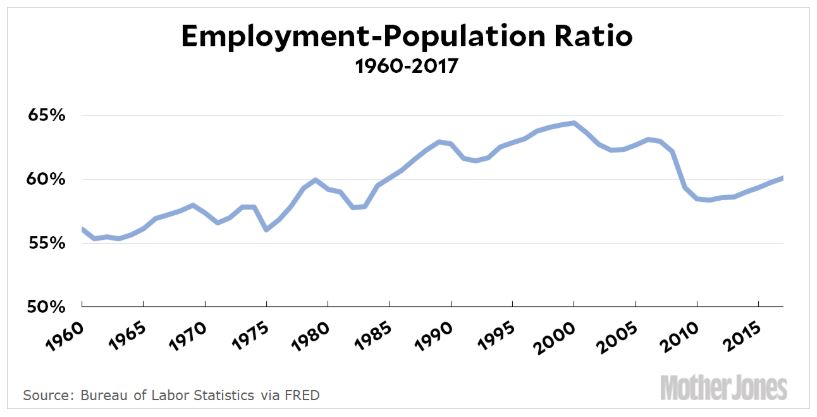
But it just seems to me the government by itself would not be the ideal source for creating the innovative high-tech jobs of the future, nor would those careers likely be jobs of higher productivity commanding the corresponding higher pay. So should the government put the onus on themselves to guarantee everyone a job, they could be making jobs out of thin air with little value just to fulfill their pledge. Being employer for millions more workers may not be in the government’s wheelhouse, so the focus should be coordinating with the private sector for creating en masse more productive careers that earn a livable wage. The fact the unemployment rate is currently so low shouldn’t distract us from how most new jobs being created are low-paying service positions, & looking ahead how automation, robotics & A.I. are projected to replace many current jobs humans now do. And even in the now, we’re seeing our modern economic system is virtually broken for the bottom half of the income chain, where a livable wage is more a pipe dream. Bringing back the American Dream first requires recognition our present & future economy needs a major fix. Yes Houston, we do have a problem: stop-thinking-small-we-need-something-better-than-a-jobs-guarantee.
So the challenges of the future point towards mass displacement of employees & there won’t be nearly enough good jobs to go around (disappearing-jobs-around-the-world-in-pictures). Our economic viability moving forward demands we reinvent millions of productive new careers, & robust economic growth requires a prosperous middle class with disposable incomes. So nice try progressive liberals, I’m glad you’re proposing something since maybe the discussions can hopefully bring moderates & conservatives into the game, so together we can somehow/someday/someway agree on viable ideas for fixing the long-term structural problems of workers perpetually stuck in redundant, low-paying, dead-end careers. And nice try conservatives, pushing through the Trump tax cuts where revenues disproportionately went to wealthy corporate interests, thinking somehow the benefits would magically trickle down to the working middle class. Liberals & conservatives alike at least have made their way to the right church, but they’re still sitting in the wrong pews with their plans missing the mark. Maybe by putting our partisanships aside long enough to meet in the middle, we could find the sweet spot for crafting real solutions to the core problems, not just skirt around the edges treating the symptoms. See dems-job-guarantee-isnt-nearly-as-easy-as-it-sounds & I’ve also posted excerpts here patched together from case-for-jobs-guarantee-sanders-booker-gillibrand, in the hopes political leadership from all stripes can join in on seeking transformational remedies, which the last sentence states we should all pitch in:
The policy wonk community is rather suddenly being torn apart by a phrase that lurked in incredible obscurity just a few months ago: “jobs guarantee.” The idea, which exists in different forms, is that the government ought to accept responsibility for ensuring that everyone who wants to work can get a job — directly hired by the public sector if necessary. The idea dates back at least to French socialist Louis Blanc’s mid-19th-century plan to establish “national workshops” to guarantee employment to the poor. Franklin Roosevelt in his 1944 State of the Union address spoke of establishing “the right to a useful and remunerative job in the industries or shops or farms or mines of the Nation,” and the concept is enshrined in the United Nations’ universal declaration of human rights. And now Democrats are increasingly talking about bringing the idea back. A better approach might be to take the jobs guarantee movement seriously rather than literally. Historically, Blanc’s national workshop scheme never really worked out, but the spirit of FDR’s right to a useful and remunerative job did live for a generation or so after his speech. Recessions were short and tackled forcefully. Unemployment was kept low, and wages steadily rose as a result. Even as Keynesian zeal began to fade in the 1980s, full employment remained a policy priority.
But the 21st-century labor market has been persistently weak, and people have suffered as a result. The time is right for a big plan to turn that around. Maybe you call it a “jobs guarantee,” or maybe you call it “full employment,” or maybe you call it something else. But the idea of doing something big to make it dramatically easier for people to find work makes sense, and it’s popular. From 1948 to 2000, the American labor market had its share of ups and downs, but there was a steady upward trajectory toward a larger and larger share of the prime-age population having a job. Since 2000, that trajectory has reversed. Even with the overall national unemployment rate now low, the share of 25- to 54-year-olds with a job remains lower than it was during the 2007 peak, which was itself lower than it was at the 2000 peak. They got resounding 52-29 support, a key sign that the notion of taking affirmative measures to put people to work continues to resonate with the public. The crucial thing is not to overreach. An ambitious program to get millions of people off the labor market sidelines and into employment while crushing the conservative drive to reinflict the mistakes of welfare reform on America’s most vulnerable people is a really good idea. It doesn’t need to also completely turn the American economy upside down. (The jobs guarantee) polls well, and while some versions of the idea are unworkable or a hazy rhetorical smokescreen for total transformation of American society, others are perfectly sensible. Rather than argue about the phrase, people who agree that macroeconomic policy in the 21st century has been too complacent about the state of the labor market should pitch in and put our own better ideas into the mix.
Coming Blue Wave?
This article points out the Dems do need to do a much better job reaching out & resonating with the working class: democrats-cant-give-up-on-white-working-class-voters. In these excerpts from democrats-were-looking-at-suburban-districts-now-theyre-glancing-toward-rural-ones-too, more hopes or dread for a blue wave abounds depending upon one’s political affiliation:
In each of these races, Republicans spent heavily to make sure they defended what should be considered safe territory, bailing out several candidates who did not raise enough funds on their own. But November presents a different challenge, as anywhere from 50 to 100 Republican seats will need to be defended, while only a handful of Democratic seats are expected to be up for grabs. The national GOP committees and super PACs will not be able to prop up Republican candidates the same way they have in the special elections. It’s left some Republicans wondering who has heard the wake-up call. “There is a wave out there that I do see coming, and I think to deny that is an unwise position to take,” said Rep. Tom Reed (R). There are almost 90 districts held by Republicans where Trump got a smaller share of the vote than in Reed’s, places that Democrats never dreamed of competing in a year ago. To be sure, Maloney is not expecting to win that many seats, particularly those in some deeply rural districts. But he is increasingly confident that the political environment could not be better for Democrats in the original target areas. “It spells doom for a certain layer of Republicans, in the kind of suburban districts that are offended by the president,” he said.
Isn’t this what we’ve seen of Trump brushing aside responsibility & reassigning blame: Trump-s-GOP-becomes-the-party-of-The-buck-always-stops-somewhere-else. More articles to check out include trump-is-where-the-end-begins & also Ted-Cruz-tries-to-keep-Obamacare-repeal-and-his-Senate-career-alive. And wouldn’t this be wonderful if we could dump the congressional hardcore radicals? Draining the swamp of corrupt political figures would necessitate voting out the worst swamp creature of all, as seen in this link devin-nunes-is-the-emblematic-republican-hack-of-the-trump-era & an excerpt from forecaster-nunes-seat-no-longer-safe-republican. America could become a better place should a monster blue wave actually sweep out such extremists like Nunes & gridlock-Teddy Cruz:
Rep. Devin Nunes’s (R) California seat is no longer considered a “safe Republican” seat, a top election forecaster said this week while shifting its outlook for several House races. Sabato’s Crystal Ball at the University of Virginia’s Center for Politics moved Nunes’s seat to “likely Republican” as his Democratic challenger, Fresno County Deputy District Attorney Andrew Janz, continues to have fundraising success.
Inside kasich-i-didnt-leave-the-republican-party-the-republican-party-left-me & also gop-gov-john-kasich-i-didnt-leave-the-republican-party-the-republican, Kasich is absolutely correct! The GOP has left a lot of us, although this article suggests we should hang in there heres-why-nevertrumpers-should-stay-in-the-gop-it-might-help-save-democracy, which I’ve chosen to relentlessly call out the party. We’re basically left without a party with the Dems lacking good ideas: swing-back-sweet-pendulum (& same with the GOP republicans-beginning-to-regret-having-no-agenda plus also see trump-handed-the-agenda-to-conservatives-and-they-blew-it). Since the GOP abandoned rational conservatism, instead becoming the party of the cult of Trump, being led by far-right extremists, advancing lies while sacrificing truth & integrity, plus adhering to tribal values over human values, the current GOP no longer represents a force for good in America. Rubin has an article on Kasich john-kasich-diagnoses-the-gops-woes which concludes with this:
Kasich would like to get back to that GOP, as would a good many Republicans. It is far from clear, however, that there is a market for that ethos or that there are mature politicians ready to tell voters that they don’t agree with mindless talk-show radio entertainers or conspiracy theorists. I’d like to think that if GOP politicians would offer something saner, kinder and milder than Trumpian crackpot-ism and xenophobia, then an audience would materialize. However, with each capitulation to President Trump and each assault on rational governance, that hope fades. There is a chunk of the electorate up for grabs in 2018 or 2020 (or already willing to vote against any enabler with an “R” after his/her name) that is amenable to a third party or to a centrist Democratic Party. Kasich may have a great deal to do with the alternative to Trumpism that emerges. Disaffected Republicans need an option; more important, the country needs a responsible center-right party.
In a lot of ways, the party has actually become dangerous, from which we need to cleanse DC of the more toxic swamp monsters. Here’s another link to the perils the GOP faces in the midterms trump-dismissed-warnings-from-gop-leaders-that-party-could-lose-house, & another one trumps-reality-distortion-field-could-help-tank-republicans, plus as we see in this beginning to the article trump-midterm-elections.html, Trump’s oblivious optimism doesn’t acknowledge he is the main problem:
President Trump is privately rejecting the growing consensus among Republican leaders that they may lose the House and possibly the Senate in November, leaving party officials and the president’s advisers nervous that he does not grasp the gravity of the threat they face in the midterm elections. Congressional and party leaders and even some Trump aides are concerned that the president’s boundless self-assurance about politics will cause him to ignore or undermine their midterm strategy. In battleground states like Arizona, Florida and Nevada, Mr. Trump’s proclivity to be a loose cannon could endanger the Republican incumbents and challengers who are already facing ferocious Democratic headwinds. Republicans in Washington and Trump aides have largely given up assuming the president will ever stick to a teleprompter, but they have joined together to impress upon him just how bruising this November could be for Republicans — and how high the stakes are for Mr. Trump personally, given that a Democratic-controlled Congress could pursue aggressive investigations and even impeachment.
Tainted Love….
This song could certainly apply to a number of Trump’s relationships. It may best describe his blossoming liaison with Kim Jong Un. It represents the uneasy connection he has with leaders of his own party. And the love affair Trump had with the media & vice versa during the campaign has been badly tainted. How about all the staff members who have departed. Or close allies around the world. Or close alliances with evangelicals. Or the love affair with his base in general. And his beloved echo. Or the sexual affairs ending in threats & hush payments. And tainted love, what better way to describe the man-crush Trump has on Putin?

(Click on image for full video)
Recent Comments