

The American Dream is Dead & Needs Revived….Trump has been selling off our future by goosing the economy now. The massive tax cuts at the top intended to trigger trickle down are producing a slow trickle that is barely perceptible. The wealthy are largely pocketing the money for themselves, with the highly touted wage growth being mostly nonexistent. The price of this reckless fiscal policy looks to usher in an era of trillion-dollar deficits for as far as the eye can see. In every part 3 message we post, there are always a wide array of problems we detail in our commentaries & articles from major news sources. That the American Dream is dead might be a statement a little too strong, but we’re on that path, & for way too many Americans it’s already dead. The purpose of my comments is not to depress everyone, but to reveal the real challenges so the American people can hold their DC representation accountable, since our political leadership has done an abysmal job of even identifying what the problems are, let alone how to fix them. Most leaders are playing it safe & sticking to the party line, hiding behind the (largely misleading) good impressions about the economy & other issues, since not rocking the boat is often their ticket for staying under the radar & getting reelected.
For whatever reason, be it lack of skills, skills mismatched for the available jobs, lack of initiative, laziness, mental issues, drug addictions, living off the government dole, or try filling in the blanks with other possible reasons….we need more men of prime working age to get back on the job. It’s become a huge drain on our economy. See the posts here from american-men-still-aren-
For prime-age women, the employment-population ratio is back to its peak from the previous business cycle, and within 2 percentage points of its all-time high in March 2000. Given that most women who aren’t formally in the labor force report that home responsibilities are what’s keeping them out (that is, they are working; they’re just not getting paid), one has to wonder just how much higher the women’s employment rate can go during this expansion. The example of the Scandinavian countries, where ambitious gender-equality efforts and generous provisions for child care have led to the highest female employment rates in the world, suggests that policy changes could push the rate significantly higher, but there’s no indication that such policy changes will be coming soon in the U.S.
For U.S. prime-age men, meanwhile, the employment-population ratio is still almost 2 percentage points below its peak from the last business cycle, and nearly 10 points below its all-time high (the data series goes back to 1948) in March 1953. Countless studies have addressed the possible causes of this disappearance of prime-age men from the workforce, and I’m not going to go into them here. It just seems worth noting that, even with the unemployment rate dipping to levels last seen on a sustained basis in the 1960s, there are still a lot of prime-age men out there without jobs (8.6 million in total, according to the BLS) who could conceivably be put to work.
Socialism Coming?
If the American Dream is dead or dying, desperate Americans will opt for something else. I’ve been warning about a coming shift towards socialism for a long time. My main argument is in our current capitalist structure, at least half of American working-class families are struggling to make ends meet. Do not buy the constant hype of such wonderful conditions with low unemployment rates & a strong economy! Sure, for many the economy is great. And there are plenty of jobs out there, but most of those jobs stink! If we can’t find a way to fix capitalism for workers, the frustration that’s boiling over out there which got Trump elected, next time could manifest itself by voting for the exact opposite ideological extreme. We’d better come up with real solutions for making free market capitalism work for those outside the upper crust, & do it very soon! Without true opportunity for the majority of Americans from shared economic growth, the 2020’s may well mark the time in our nation’s history where we transitioned over into a type of socialism. That is not a preference from me, rather it is a warning. Those who still love capitalism (& benefit the most from our current system) had better wake up & find a fix….QUICKLY!!! See these excerpts from what-are-capitalists-
I’ve been fretting lately about the state of mind of America’s capitalists. All these socialists coming out of the woodwork must have them in quite a lather. So I write today with some friendly advice for the capitalist class about said socialists. You want fewer socialists? Easy. Stop creating them. Every once in a while in history, cause and effect smack us in the face. The conditions under which the czars forced Russians to live gave rise to Bolshevism. The terms imposed at Versailles fueled Hitler’s ascent. The failures of Keynesianism in the 1970s smoothed the path for supply-side economics. And so it is here. As I noted recently in The Daily Beast, the kind of capitalism that has been practiced in this country over the last few decades has made socialism look far more appealing, especially to young people. Ask yourself: If you’re 28 like Alexandria Ocasio-Cortez, the New York congressional candidate who describes herself as a democratic socialist, what have you seen during your sentient life? You’ve seen the United States go from being a country that your parents — or if you’re 28, more likely your grandparents — described as a place where life got better for every succeeding generation to a place where for millions of people, quite possibly including you, that’s no longer true.
As that happened, you’ve seen the rich get richer, and you’ve perhaps noticed that the government’s main response to this has been to keep cutting their taxes (in fairness, President Barack Obama did raise the highest rate in 2013 to 39.6 percent from 35 percent, although for single filers, that rate didn’t kick in until earned income went above $400,000). You witnessed the financial meltdown of 2008, caused by big banks betting against themselves. Capitalists might want to consider how all that looked to a young person who came from a working-class family and who probably knows someone who lost a job or even his house, while some of the bankers who helped create the mess walked away with golden parachutes, like that of Countrywide Financial’s Angelo Mozilo, which The Times valued at $88 million. You’ve watched corporations horde profits, buy back their stock and not reinvest in their workers the way they once did as they move jobs to Central America and Bangladesh. If you read a lot, you know that stock buybacks were permitted under the Securities and Exchange Commission’s Rule 10b-18, which dates to the Reagan era, and that since it’s just an S.E.C. rule, it can be changed without having to pass legislation, but no one in either of the Democratic administrations since then bothered. I could go on like this for 20 paragraphs. Many more, in fact. But you get the idea. Back in the days when our economy just grew and grew, we had a government and a capitalist class that invested in our people and their future — in the Interstate highways, the community colleges, the scientific research, the generous federal grants for transportation and regional development. And, funny thing, during all this time, socialism didn’t have much appeal.
The median income picture has been much spottier, hardly increasing at all in inflation-adjusted dollars over 18 long years. And those incomes at the top have shot to the heavens. So if you were a person of modest or even middle-class means, how would you feel about capitalism? The kind of capitalism this country has been practicing for all these years has failed most people. Yes, it’s given us lots of shiny objects to gush about. A smartphone that can display slow-motion video is a wonder. But an affordable college education, though perhaps not a wonder, is a necessity for a well-ordered society. So is a solution to a national drug crisis in which 115 people die every day, as well as a lot of other problems that the capitalism of our era has simply ignored. I have mixed feelings about this socialism boomlet. It has yet to prove itself politically viable in general elections outside a handful of areas, and by 2021 we could wake up and see that it’s been a disaster for Democrats. But I understand completely why it’s happening. Given what’s been going on in this country, it couldn’t not have happened. And if you’re a capitalist, you’d better try to understand it, too — and do something to address the very legitimate grievances that propelled it.
Wage Stagnation
I saw these comments from economic consultant Joel Naroff about the latest jobs report in Newsmax Finance: The labor force grew and the participation rate was stable. The one disturbing number was the wage increase. It was decent, but over the year, the 2.7% gain means that real wages are up less than 1% over the year. That is pathetic. Based on these excerpts from trump-real-wages-
Paul Ryan tried to brag about the economy last week, and it didn’t go so well. “Not too long ago, progressive economists said strong economic growth couldn’t be done anymore — that a stagnant U.S. economy was the ‘new normal,’” Ryan tweeted. “And yet, our economy is growing at its fastest rate since 2014.” Ah, yes: the good old days of 2014, also known as the sixth year of Barack Obama’s presidency. Ryan’s nostalgia for 2014 wasn’t even the most-mocked part of his tweet. His attempt to make grand claims about a single quarter of growth was. If the Trump economy were so wonderful, why would the speaker of the House feel the need to traffic in disingenuousness? Because the Trump economy isn’t actually so wonderful. For most Americans, it is downright mediocre, and it has deteriorated somewhat since President Trump took office, despite the healthy G.D.P. and unemployment statistics.
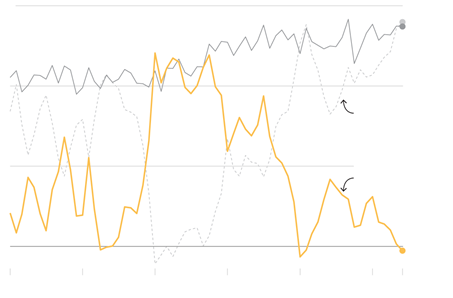
A Slump for Real Wages….Change over the preceding 12 months in average hourly wages and in the Consumer Price Index
Source: Bureau of Labor Statistics | By The New York Times
The chart here tells the story. It shows the trends in average inflation-adjusted hourly pay, arguably the best measure of economic well-being for most people. As you can see, hourly wages are suffering through a Trump slump. That slump isn’t entirely Trump’s fault, by any means. But he deserves some blame for it. Worst of all, he is doing virtually nothing improve the situation, instead enacting policies that will ultimately hurt workers’ ability to earn a decent paycheck. Let’s start with the good news. The unemployment rate keeps falling, and economic growth is solid. These headline numbers are the ones that Republicans emphasize (and that the media sometimes overhypes). As a result of the growth, nominal wages — that is, the numbers people see in their paychecks, before taking inflation into account — are growing. You can see the pickup in the gentle upward slope of the chart’s solid gray line. Over the past year, the average hourly nominal wage has risen 2.7 percent. There are two problems, though. First, 2.7 percent isn’t a great growth rate for nominal wages. It was rarely so slow in the entire second half of the 20th century, for example. These days, though, most workers don’t receive their fair share of economic output. An outsize share instead flows to corporate profits and the rich.
Add it all up — faster inflation plus mediocre nominal-wage growth — and you get a stagnation in real wages. Welcome to the Trump wage slump. My best guess is that real wages will do modestly better over the next year, barring another oil spike or an unexpected recession. But there is no reason to think that most Americans are on the cusp of truly healthy pay increases. They face too many obstacles: Companies that are larger and more powerful than they used to be; unions that are weaker; and, thanks in large part to Trump, a federal government that keeps siding against workers, be it on overtime pay, work rules, health care costs, for-profit-college scams or tax cuts. Right now, Trump is presiding over precisely the wage growth that he deserves: zero.
Stuck in Dead End
In the aftershock of a severe economic downturn & the American Dream is dead for so many Americans, the anger & frustration has spawned a form of extremist politics on both sides: america-10-years-after-
It’s an axiom among many Americans that each future generation will live better than its predecessor. New technologies, greater efficiencies and a can-do spirit will reward us with higher living standards. There might be periodic stumbles, but the long-term trajectory is up. And the people most guaranteed to enjoy this bountiful future are the children of today’s upper-middle class. They have all the advantages: attentive parents, good schools, a college education and job-market connections. That’s the conventional wisdom. Ditch it. If you are an upper-middle-class parent, as I am, you must have noticed that the real world isn’t playing according to script. Among many young Americans, there is downward mobility. The children aren’t achieving what they (and their parents) expected. Even when they have (and many have), the gains could be eroded in the future. The trajectory is not inevitably up. Parents worry about their children’s fate.
Partly, this reflects the memory of the 2007-2009 Great Recession and its huge job losses. But it’s more than that. Compared with their elders, many younger Americans are doing worse. Despite today’s strong economy, they’re falling behind. We know this from an important study by Raj Chetty and fellow economists from Stanford University, Harvard University and the University of California at Berkeley. By merging various databases — which had been stripped of names and identities — they could measure the pretax family earnings of children and parents when they were both about 30 years old. What they reported is fascinating. About 90 percent of children born in 1940 ultimately exceeded their parents’ incomes. That is, almost everybody. This makes sense; the babies born in 1940 were affected by both the 1930s’ Great Depression (which reduced incomes) and the post-World War II economic boom (which raised incomes). However, for children born in 1970, only 61 percent earned more than their parents, and for those born in 1980, only 50 percent did. That’s a sea change. It suggests that we’re already at the point where many in the present and next generations of younger Americans won’t live as well as their predecessors. If current trends continue, that certainly will be true.
You can see the consequences among millennials, those born from 1981 to 1996. Their squeezed incomes have forced them to rearrange their lives. They’re marrying later, buying homes later, having children later and — to save money — living longer with their parents. What’s also surprising is that the biggest losers seem to be the children of the middle and upper-middle classes, precisely those who are supposedly most protected against adverse changes, according to a new study by Brookings Institution scholars Richard Reeves and Katherine Guyot. “For many people, [economic success] does consist of doing better than your parents did,” they write. “This seems to have become steadily harder to achieve for those born into middle-class families in particular from 1950 onward.” Economic anxiety is increasingly an equal-opportunity affliction. No one can escape it. The poor worry about staying poor. The lower-middle class worries about paying bills or losing jobs. Now upper-middle class parents have joined the crowd, because their own well-being is often judged by how well their children are doing. That is the stubborn source of their angst.
Struggling Families
Way too many workers have fallen through the cracks, as again I say for many the American Dream is dead. It’s a similar problem with workers around the world with major corporations able to exploit the masses: larry-summers-on-the-
Talking to friends and colleagues about the themes in this book, I have discovered that it is hard for those of us in the upper middle class to admit that we are part of the inequality problem. But once we do, there is an upside. We can be part of the solution, too. As a class, we are a powerful bunch. For one thing, we are assiduous voters, with a turnout rate of almost 80%. But we are influential outside the polling station. The most potent form of power, according to Bertrand Russell, is “power over opinion.” This is a kind of power we understand. Pretty much every position in the influencing business is in fact filled by a member of the upper middle class: journalism, academia, research, science, advertising, polling, publishing, the media (old and new), and the arts are, almost by definition, upper middle class strongholds. But upper middle class power tends to be deployed to protect our own position and status, regardless of considerations of fairness. Having convinced ourselves of our own merit, we have become — and there is no way to say this nicely — kind of selfish.
In Coming Apart , Charles Murray urges a “civic Great Awakening” during which the “new upper class” will “take a close look at the way they are living their lives . . . and then think about ways to change.” But it is not exactly clear what change Murray wants from them, other than to stop being so shy about preaching moral virtue and so gauche about their consumption. In fact, Murray explicitly says, “I am not suggesting that they should sacrifice their self-interest.” Conservatives assure us that it is the poor or immigrants who are to blame. Liberals protest that the super-rich are ruining America. Either way, whatever our political leanings, those of us in the upper middle class can be reassured that we are the good guys. But this strategy of placation has run its course. The paralyzing fear of upsetting the upper middle class has simply spared us from some necessary, even if painful, criticism. While the majority is struggling, the upper middle class is flourishing. Recognizing this fact is a necessary step toward creating a political climate in which real change is possible.
But I have come to realize that what really draws me, has always drawn me, to America is the nation’s spirit of openness and promise of social equality. I always hated the snobbery and class distinctions of the United Kingdom. But the harder I have looked at my new homeland, the more convinced I have become that the American class system is hardening, especially at the top. It has, if anything, become more rigid than in the United Kingdom. The main difference now is that Americans refuse to admit it. According to the historian Richard Hofstadter, the impulse that fueled the Progressive Era was in large part a self-critical one. “The moral indignation of the age was by no means directed entirely against others,” he wrote in The Age of Reform. “It was in a great and critical measure directed inward. Contemporaries who spoke of the movement as an affair of the conscience were not mistaken.” A similar period of reflection is required now, if the conscience of the upper middle class is to be awoken and if we are once again to share, rather than to hoard, the American dream.
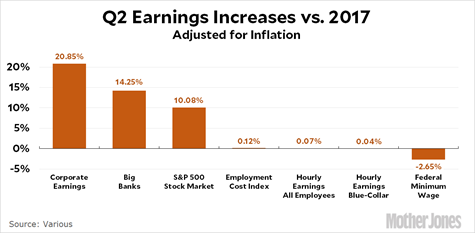
See this graph from trickle-down-economics-
Out Here in the Heartland
I’m from here in the Rust Belt. I hate that name but can’t really make a case it’s a wrong description. I’ve watched the steady decline over decades of our manufacturing base, with many factory towns being a shadow of their former selves. We need better ideas how to restore better jobs, even if it’s not the old factory jobs. An idea is presented in these excerpts from how-to-save-the-troubled-
But at the local level, it’s a different story. Even as the U.S. federal government has largely refused to pick winners (except perhaps for the financial sector), cities and towns have been vigorously working to promote specific business and industrial clusters. Those local efforts have received relatively little attention, but they could be key to the revival of many of the country’s struggling regions. Veteran journalist James Fallows and writer Deborah Fallows (a married couple) document this process in their recent book, “Our Towns: A 100,000-Mile Journey into the Heart of America.” The book is billed as a Tocquevillian quest to rediscover the heart of American small-town civic cooperation and democracy — a pushback against claims by people like sociologist Robert Putnam that the country is falling into a state of isolation and anomie. But it’s also an insightful and penetrating exploration of how American cities can get back on their feet after devastating blows from the Great Recession, the China trade shock and the deindustrialization of the Rust Belt.
In general, Fallows and Fallows find that the most successful cities are those where the government, the private sector and nonprofits all work in concert with one another. This idea of public-private partnership stands in contrast to free-marketers’ disdain for government intervention, as well as socialists’ contempt for the profit motive of corporations and entrepreneurs. To save a city, the authors write, you need both. Public-private partnerships can provide the specialized education needed to nurture a flagship industry like aerospace manufacturing or agricultural technology. They can provide needed infrastructure, revitalize downtown areas, lure companies away from big cities, and work to funnel immigrants into gainful employment. This is the essence of local industrial policy. The U.S. has been hit by many economic shocks and dislocations during the past half-century. But its local government, business and civic leaders have never stopped working to revitalize their towns, instead of giving up and moving to the coast. Their valiant efforts shouldn’t be left out of the national conversation.
Health Care
Here’s an article stating single-payer universal healthcare is inevitable. The GOP failed to replace Obamacare with something better, & now they have a hodgepodge approach which is failing to contain premiums or effectively cover preexisting conditions. See these excerpts from medicare-for-all-trump:
But it’s also thanks to the Trump administration, which, having failed to repeal the Affordable Care Act, has undertaken a nearly unprecedented campaign of regulatory malfeasance that aims to prevent it from functioning and minimize the number of people on whom it bestows comprehensive health coverage. There are lots of alternatives based on subsidies and regulations that work in principle and are used in practice in many European countries. But in a democracy, a workable regulatory system needs to be able to survive the regular alternation of parties in power. The lesson of the Trump era is that the Obamacare approach can’t do that. It’ll take a big, dumb program that just keeps trundling along unless Congress actually repeals it — like how Social Security checks keep going out no matter who’s president.
As a candidate, Donald Trump promised to replace the Affordable Care Act with something “terrific” and vowed to create a system that would “take care of everyone.” More conventional Republicans were less explicit, but virtually all of them from Mitch McConnell and Paul Ryan on down were clear in their criticism of the high premiums and deductibles facing many people on the ACA exchanges and their desire to “replace” the Affordable Care Act with something that would still protect patients with preexisting conditions. When it came time to write actual repeal laws, it turned out they were all lying — the idea was to enact a big tax cut and pay for it by giving fewer people lower-quality health insurance. It proved to be politically toxic, but Republicans almost did it anyway — passing a hideously unpopular bill through the House and securing 49 votes for a Senate bill so terrible that many Senate Republicans denounced it even as they voted for it. But it didn’t pass, Doug Jones won a Senate special election in Alabama, and Republicans moved on to their true passion of just cutting taxes with no offsets at all. Then came the time for Trump and his administration to govern, and they’ve consistently done so in ways that degrade the quality of insurance available to middle-class exchange buyers. All of this has the effect of pushing Obamacare premiums higher, because it undermines the core regulatory bargain at the heart of the law. The ACA vision was to create a well-functioning market of competing private insurance plans based on the concept that if everyone bought insurance, then insurers could be forced to cover patients with high levels of medical needs without charging exorbitant premiums. On average, costs would be contained across the population, and everyone would get the peace of mind and preventive care that comes with being enrolled in a comprehensive health insurance plan.
But they also don’t have anything constructive to say on the subject. As Jonathan Chait writes, “having spent years insisting they had an army of wonks who could design a better alternative to the Obamacare ‘train wreck,’ the Republican plan of attack has dissolved into a rearguard sabotage campaign with no pretense of doing anything to help the poor and sick afford medical care.” The simple fact is that though they don’t like to admit it, they just disagree with the moral premise that the government has an obligation to ensure that people get the health care they need. And that’s going to mean doing it the old-fashioned way — by enrolling as many people as possible, including, ultimately, everyone in government programs that keep operating unless Congress actually repeals them. The notion of a compromise strategy that would allow Democrats to achieve their basic goals while being flexible and industry-friendly with the means was appealing on a number of levels, but it depended fundamentally on the notion that Republicans would treat such a compromise as stable. The reality is they won’t, so Democrats will have to choose — either abandon a generations-long principle (which isn’t going to happen) or move forward into the single-payer future.
False Accolades
In statements, speeches or tweets, he’s constantly throwing out false statements about the economy just because he has this insatiable need to brag on himself. More of his hyperbole are found in excerpts inside trump-us-steel-plants-
Trump is in the habit of making stuff up to make himself look good. During a roundtable event in Iowa late last month, Trump touted “record business” for the association health care plans he champions as better alternatives to more robust ones mandated by the ACA. He did that despite the fact association plans won’t even be available until September. Trump has also repeatedly touted the imminent unveiling of mysterious health care proposals that never end up materializing.
Trump’s baseless boasts put other Republicans in tough spots. During a CNN interview on Friday, Rep. Ryan Costello (R-PA) was in the unenviable position of having to respond to Trump’s claims about new U.S. Steel plants. “So U.S. Steel of course is based in your state — do you know anything about these seven plants? Any announcements you want to share with us?” anchor Erica Hill asked him. “I don’t have any announcements on that front,” Costello said. “Let’s be honest — I do hope we do hear an announcement from U.S. Steel, but I don’t know of anything, no.”
Midterms
There is one overriding anchor that will weigh down the GOP for the midterms, plus he’s the huge factor energizing the Dem base: gop-strategist-to-
It’s fine. Any president would boast about this unemployment rate, and there’s no doubt it’s these kinds of economic numbers that are keeping his approval rating north of 40%. But every time I see a jobs report and see Trump tweet about greatest this and best that, I can’t help but think about the longer economic story of this country, a story that—surprise, surprise—the Democrats have failed to tell Americans, and for which they pay some kind of price in every election. If you’re a typical person, even if you’re pretty well-informed, you probably believe that the Republicans are the party of big business and private enterprise. You probably believe on some level all the things the Republicans say about the free market—for example, that regulations are a job-killer. Mind you, you may be a liberal and still support regulations for other reasons, including that they save lives in the workplace or are good for the environment. But I bet some part of you still believes that the Republicans are the party that’s been better for business. After all, they say it all the time, and the Democrats never, ever say otherwise.
Well, like most other things Republicans say these days, it’s not true. In fact, it’s not even remotely close to true. The economy does better under Democratic presidents. Indeed, it does a lot better—so much better that economists are almost kind of confused by it. The most authoritative recent study of which I’m aware was done in 2016 by Princeton economists Alan Blinder and Mark Watson. Now I’ve known these kinds of numbers for a long time, because I occasionally read things like reports of the St. Louis Federal Reserve Bank. And I spent years wondering: Why don’t Democrats ever mention this? I’m no expert on these things, but “we’ve been better for the economy over the last 60 years, and here are the numbers that prove it” seems like a pretty good line to me.
And even if it’s exaggeration because “the economy” is such a complex thing, it is by political standards very admissible exaggeration. Finally—one did! Remember Bill Clinton’s speech at the convention in Charlotte in 2012? He talked about it. He did a beautiful job of connecting these results to Democrats’ values, and for my money it’s the single best convention speech of the postwar era. “It turns out that advancing equal opportunity and economic empowerment is both morally right and good economics, because discrimination, poverty, and ignorance restrict growth, while investments in education, infrastructure, and scientific and technological research increase it, creating more good jobs and new wealth for all of us,” he said. But that was six years ago, and I’ve hardly heard a Democrat talk that way since. If his wife did in 2016, she sure didn’t emphasize it.
Teddy, Immigration & Chicago
GO BETO!!! It’s time to send gridlock-Teddy packing!: beto-orourke-is-
Runaway American Dream
More signs the American Dream is dead or dying is seen in american-dream-steven-
(Click on image for full video)
Recent Comments