

Economy Section
The very same economic conditions he would always blast Obama about, he’s now raving about it only because he’s now the one in the White House. But the basic underlying conditions remain the same. Stagnant wages, low participation rates, part-timers who’d prefer to work full-time, & roughly half the working population struggling to make ends meet. Investors love the prospect of tax cuts which is reflected by the rising stock market lately which Trump brags about, but that is largely benefitting those already doing well. The tax cuts likewise will mostly benefit those doing well rather than low-wage workers who really need the help, along with increasing the deficits more than economic growth. That tea party grievance a few years ago about out-of-control debt must only apply when a Dem is in the White House. So in raising deficits, there’d better be substantial benefits coming from this, but will the middle class really benefit as Trump claims? The tax cuts seem to be going mostly to the wealthy & reducing Donald Trump taxes. Our nation could definitely use tax reform if we could ever do it in a smarter way.
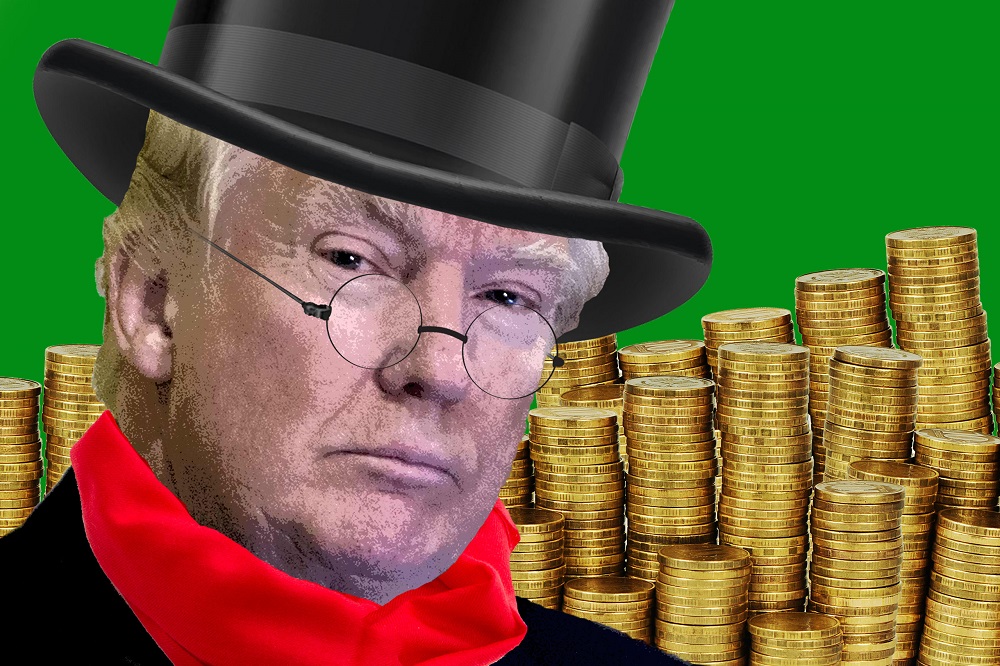
So it’s hard to find the logic for this tax bill, other than Trump & a GOP Congress are grasping at straws looking for a way to justify their leadership positions. The bill also undermines Obamacare by repealing the individual mandate. And just like Obamacare was originally jammed through, the GOP is trying to rush the tax bill through on a partisan basis before we fully understand what’s really in there. There will be some benefits from increased incentives to reinvest in the United States & boost job creation, but the optimistic projections coming from GOP DC leadership are way overblown. Americans’ approval of the tax bill is running at about 1/3 of the population, in line with Trump’s approval ratings. The general consensus is indeed it’s mainly a tax cut for the rich, which is generally likely true. This tax bill looks ready to pass just in time for Christmas, like something out of A Christmas Carol where Ebenezer Scrooge hordes the profits for the rich while the enslaved laborers are subsisting off the scraps. Assuming this does pass (still very much in question), the performance of the economy going forward will determine whether this bill becomes a boon or boondoggle for the GOP.
So leading off the related articles below would be unmasking the struggles of Americans in poverty & debt, along with the incredible levels of income inequality. After that, we once again see numerous articles on the tax plan, which reveal the many problems with the bill that the GOP still hopes to jam through this year. There are also links to informative reports on a potential government shutdown, Puerto Rico, child tax credit, CHIP, drug prices, opioids, Monsanto’s dangerous herbicides & Sandy Hook. There sure are plenty of problems out there our divided government seems hapless in addressing. Check out these enlightening four paragraphs I pulled from the Guardian article, Inequality is not inevitable but the U.S. experiment is a recipe for divergence:
But this boomtime at the very top has not benefited the rest of the American population in any measurable way. The average annual wage of the bottom 50% has stagnated since 1980 at about US$16,000 per adult (after adjusting for inflation and before taking into account taxes and transfers). It’s a tale of two countries: the top half has been growing at roughly the same rate as China, while for the 117 million American adults in the bottom 50%, income growth has been nonexistent for a generation. In western Europe, by contrast, incomes of the bottom half have matched overall economic growth over the last quarter of a century.
What explains this dramatic divergence? The US has experienced a perfect storm of radical policy changes which have all contributed to this surge in inequality. The tax system, which used to be progressive, has become much less so over time. The federal minimum wage has collapsed, unions have been weakened and access to higher education has become increasingly unequal. At the same time, deregulation in the finance industry and overly protective patent laws have contributed to booms on Wall Street and in the healthcare sector, which now makes up 20% of national income.
These forces led to an upsurge in wage inequality in the 1980s and 90s which did, admittedly, stabilise at the beginning of this century. Since then, though, the growing importance of income derived from capital – and the growing concentration of wealth – have been key drivers of inequality. The rich are getting older, and a growing chunk of their income comes from passive capital ownership rather than active work. It’s a second Gilded Age. The tax bill just passed by the US Senate will not only reinforce this trend, it will turbocharge inequality in America. Presented as a tax cut for workers and job-creating entrepreneurs, it is instead a giant cut for those with capital and inherited wealth. It’s a bill that rewards the past, not the future.
Many observers have been quick to blame globalisation, China and technology for the stagnation of working-class wages in the US. But the global data presented in our report offers a fuller picture. The US has run a unique experiment since the 1980s – and the results have been uniquely disastrous. Bad policy can have a real impact on millions of lives, for decades. But what governments have done, they can still undo.
In the very last group of links, Trump made a big show today out of repealing a massive amount of regulations with a prop behind him of a huge stack of paperwork. While I do agree with the premise repealing unnecessary regulation that hampers business is making progress in the right direction, the big concern is whether this administration can do it in a way that makes sense. Not only is the prez more than happy to take credit for repealing regulations that were already dead, but his recklessly impulsive actions without studying the details & ramifications, plus without putting much thought into what they’re actually throwing out, we risk the scenario of throwing the baby out with the bathwater. Some much-needed rules & protections & safety regulations are no doubt on the chopping block.
This very first article touches on a subject that doesn’t bode well for the future. Millennials generally aren’t buying into conservatism & they are the future. Kasich even said tonight on CNN the party is losing the future. The agenda & narrative of conservatism has become way too nihilistic, combative, intransigent & heartless. The GOP base & even evangelical voters have only themselves to blame. They’ve bought into & sold out to the tribal extremism that largely defines what has become of conservatism. These young people are distancing themselves from what they perceive as the dishonesty, hypocrisy & even the immorality they’re seeing in modern-day conservatism from both a political & religious standpoint. Many express a favoritism towards socialism/communism over capitalism, plus they’re exiting traditional churches. It’s imperative conservatives return to compassionate conservatism & core values, otherwise we may see a steady erosion of the GOP & evangelical churches until they shrink away to irrelevance. Just a fair warning we need to turn this around before it’s too late when the trends become too entrenched & irreversible.
So review these links to many economic concerns which leadership seems powerless to tackle. The tax plan is about to come to a head. They might vote in Congress next week. Several articles below reveal flaws in the plan, which the numbers indicate the cuts to our taxes will be nominal, with the huge cuts going to Donald Trump taxes.
Another beautiful Christmas song….
proclaiming the true reason for the season.

(Click on image for full video)
Recent Comments