
Need to Solve Economic Problems & also the Issue of Abuser of Human Rights….
That hideous & heartless policy where America is gaining a reputation as an abuser of human rights is at the bottom, but first about the economy. Trump is following his Trumpeter followers’ wishes in wanting to turn back the clock more than a half-century or so, trying to make America great again by recreating a world long gone & will never exist again. We need new/big/better ideas, plans & policies which look to the future & can successfully meet the challenges of the modern world. So while Trump invented & masterfully speaks that trumpeter-nation language in saying what they want to hear & speaking to their concerns, from the start he never had any viable solutions for fixing the chronic economic troubles.
So what we’re getting with Trump is a carry-over from the Obama economy, where job growth is good & unemployment rates have fallen to surprisingly low levels, but most new jobs created aren’t good jobs & wage growth remains tepid. Trump’s tax cuts will only make problems worse for the long run, further escalating recent trends where the gains go to the very top & annual deficits are projected to jump into the trillions. See the dismal failure the tax cuts have been shown to be thus far:corporations-are-investing-in-
Let’s Identify The Problems
Despite our bitter divides, differing ideologies & contrasting ways of viewing our world, an excerpt from what-unites-us-all-inequality
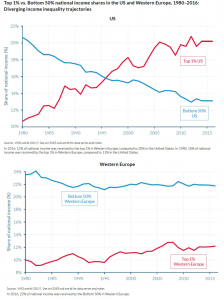
I’ve spent the past five years traveling between three communities that embody different aspects of our supposedly divided nation — liberal and conservative, exurban and rural, historic and newly built. And for all their dissimilarities, I’ve seen from these travels that we have more in common than we think. Unfortunately, though, our greatest shared experience these days is growing income inequality, which has expanded in every single state since 1979 and now is at levels not seen since the 1920s. The effects look different depending on the setting, but everywhere has been transformed by it. The rich everywhere have more than ever, and the poor can’t make it anywhere: This is our shared story in 2018.
More signs of America’s very uneven economy are presented in these excerpts from The-U-S-is-an-internation
Unemployment is low in the United States, but before you start cheering, you should know about a whole bunch of other statistics about work and workers’ rights in this country. A new report from the Organization for Economic Cooperation and Development shows just how far behind our peer nations the U.S. lags on conditions for workers—starting with having the second-highest income inequality and the third-worst share of households earning less than half the median income among OECD nations. If you lose a job in the U.S., it’s harder to find a new job than in most other countries for which there’s data, and workers who lose a job typically end up at a lower income when they do find a new one. That’s a big problem in particular because American workers are more likely to be fired or laid off than workers in many other countries. And unemployment aid in the U.S. is low and doesn’t last long. There’s another big factor keeping workers down in the U.S.: The U.S. keeps unions down, and that’s bad for all of us.
With our economic problems being so obvious & played out constantly in data showing chronic wage stagnation & increasing income inequality, it’s simply stunning we as a nation lack the willingness to discuss remedies for these issues, or the determination to take actions in fixing them! Inside this next link, corporations had a choice to make, & you can guess which one they chose: workers-or-profits-amer
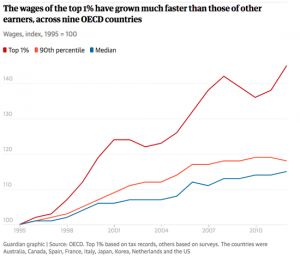
America’s unemployment rate is hovering near half-century lows. There are now more job openings than unemployed workers in the United States for the first time since the government began tracking that ratio. For America’s working class, macroeconomic conditions don’t get much better than this. And yet, most Americans’ wages aren’t getting any better, at all. Over the past 12 months, piddling wage gains — combined with modest inflation — have left the vast majority of our nation’s laborers with lower real hourly earnings than they had in May 2017. On Wall Street, the second-longest expansion in U.S. history has brought boom times — in the coming weeks, S&P 500 companies will dole out a record-high $124.1 billion in quarterly dividends. But on Main Street, returns have been slim.
Economists have put forward a variety of explanations for the aberrant absence of wage growth in the middle of a recovery: Automation is slowly (but irrevocably) reducing the market-value of most workers’ skills; a lack of innovation has slowed productivity growth to a crawl; well-paid baby-boomers are retiring, and being replaced with millennials who have enough experience to do the boomers’ jobs — but not enough to demand their salaries. There’s likely some truth to these narratives. But a new report from the Organization for Economic Cooperation and Development (OECD) offers a more straightforward — and political — explanation: American policymakers have chosen to design an economic system that leaves workers desperate and disempowered, for the sake of directing a higher share of economic growth to bosses and shareholders.
The OECD doesn’t make this argument explicitly. But its report lays waste to the idea that the plight of the American worker can be chalked up to impersonal economic forces, instead of concrete political decisions. If the former were the case, then American laborers wouldn’t be getting a drastically worse deal than their peers in other developed nations. But we are. Here’s a quick rundown of the various ways that American workers are getting ripped off:
Another interesting graph comes from Open-thread-for-night-owls-1-g
And Do Something About Them
In our modern-day cutthroat capitalist system, here’s just one of numerous ways private equity firms cash in on low income & desperate Americans, seen in a-way-of-monetizing-poor-pe
So many policy proposals aimed at reducing economic inequality emphasize moving disadvantaged people into higher-paying, higher-skilled jobs, typically with more access to education and training. We do need to invest far more in expanding opportunity for fellow citizens who have lost all hope for advancement. But there is a flaw in this thinking, as Steven Dawson argues in “Make Bad Jobs Better,” a compendium of his recent work published this year by the Pinkerton Foundation. If we define success “solely as securing a middle-class job,” he writes, “then we will limit ourselves to helping only a narrow segment of low-income workers improve their lives.” Dawson focuses on the tens of millions of Americans who do very necessary work in our society and receive little reward for their efforts. He challenges the idea that “bad jobs” are destined to be bad forever and that little can be done to enhance them.
Consider that we mourn the decline of auto, steel and other manufacturing jobs that were seen in the past as at least as “bad” as the retail and service occupations of the new American working class. It took unions working to raise pay and benefits and social legislation limiting hours and protecting worker safety to make old-economy blue-collar jobs “good.” The lesson is that what constitutes good work is a matter of social and political decision-making — and choices by employers to see their workers as assets and not merely as costs. Dawson is a pioneer in doing what he recommends. At the Paraprofessional Healthcare Institute, he helped create employee-owned cooperatives of home health-care workers, thereby converting what were once poorly paid jobs into pathways to independence, entrepreneurship and respect.
Dawson is scathing about the way our employment markets treat large numbers of very hard-working people. “A bad job is not simply the absence of a good job,” he writes. “A bad job destabilizes the individual, her family and the community. A bad job not only fails to pay enough for decent food and shelter for a worker’s family, it can risk her health, disrupt any chance for a predictable family life, undermine her dignity, and deny her voice within the workplace.” He notes that “the occupations that employ the largest numbers of low-income youth and adult workers . . . experienced higher than average real wage declines” in the years after the Great Recession. The pay drops were especially large for workers in retail, personal care and food preparation. For many who find themselves at the bottom of the economy, the bane of their lives is instability: wage theft, part-time work, seasonal work, variable hours and unpredictable schedules — the problem of “not knowing when you will be called to show up to your next part-time shift.” Low-wage jobs are also among the least safe.
Public policy has a role to play in making jobs better, starting with higher minimum wages, income supplements such as the earned-income tax credit, universal family leave and health-care coverage for everyone. We should be building on the Affordable Care Act, not gutting it. And many low-income jobs are supported indirectly by government money (Medicaid especially), so public programs should be consciously geared not just to providing essential services but also to offering platforms for the improvement of work life itself, for enriched training and for more worker voice. These can, in turn, raise the standard of the services.
Dawson looks as well to private-sector employers as part of the solution. Especially when labor markets are tight, employers have an interest in satisfied, engaged and well-trained workers who welcome responsibility. This is one reason the Federal Reserve should be wary of steps that would increase unemployment. In another useful paper, “Restore the Promise of Work,” Dawson joins the Aspen Institute’s Maureen Conway to call for lifting up “high-road employers” who “offer concrete examples of how good jobs can be beneficial to all.” Tax policy can encourage high-road practices, and Conway and Dawson note that when governments contract for private-sector services, job quality should be part of the negotiations. We should not allow the melodramas of the Trump presidency to overshadow the problems we need to solve or distract us from the reforms and innovations that could change the lives of a great many struggling people. Dawson writes that “fear and insecurity will remain, and deepen, unless having a job once again means securing stability, dignity and self-worth for ourselves and our families.” When it comes to job quality, we need to get to work.
Trade/Tariffs
I haven’t yet been complaining about the tariffs as much as most Trump critics. And it’s the issue where he’s getting the most pushback from GOP leaders & corporations. I’m waiting to see how it all plays out. I’ve been saying all along for a long time America needs more fair deals with their trading partners to level the playing field. But whatever better deals Trump can strike had better happen reasonably soon, before escalating trade wars cause some serious damage: trump-starts-a-trade-war-but-t
Nutso Montana Rally
With the deranged, over-the-top rhetoric coming from the prez in that Montana rally, along with the chants & screams of approval from the cheering mob, it really does give the appearance we’re dealing with an evil cult here: scarborough-shames-trump-rally
Without question, President Trump’s Catskills roast of a Montana rally on July 5 was a gasp-worthy disaster. Still, it was, as we used to say as kids, just more of the “same old, same old.” An hour-long rant that mixed the greatest hits from his racist and xenophobic campaign for the White House with some flecks of new material. What has changed is the heightened atmosphere of danger in which he delivered them 18 months into his presidency. The nation remains appalled by Trump’s morally bankrupt “zero-tolerance” policy, which separated migrant children from their parents at the border and set up jails for babies. Now that his feckless administration is under court order to reunite the children with their parents, its sheer incompetence is plain for all to see. Just when you thought the callous disregard for these children couldn’t get any worse, the New York Times reported last week that “records linking children to their parents have disappeared, and in some cases have been destroyed.” And don’t forget that the Trump administration is going after naturalized U.S. citizens now, too.
On the global stage, Trump continues to diminish America’s standing around the world by berating our allies and thinking Russian President Vladimir Putin is his friend. Remember the contentious Group of Seven meeting in Canada last month? The one that produced the iconic photo of German Chancellor Angela Merkel and Trump staring each other down over his balking at signing the summit communique as other leaders watched? Well, Eurasia Group President Ian Bremmer told “CBS This Morning” that after Trump agreed to sign, “He stood up, he put his hand in his suit jacket pocket and he took two Starburst candies out, threw them on the table, and said to Merkel, ‘Here, Angela, don’t say I never give you anything.’ ” And that was before Trump got into a spat with Canadian Prime Minister Justin Trudeau over trade and withdrew the United States from the G-7 joint statement. All of this chaos swirling at home and abroad was the backdrop for the president’s Montana rally last week. That’s why Trump’s run-of-the-mill rhetorical dumpster fire is rightly viewed as an out-of-control inferno by everyone except those braying in the crowd in Great Falls or those averting their complicit eyes on Capitol Hill.
It’s Who He Is
The character of the man is further revealed in trumps-personal-driver-25-year
Why did so many working class voters choose a selfish, thin-skinned, petulant, lying, narcissistic, boastful, megalomaniac for president? It’s important to know, because we need to stop more Trumps in the future. The answer lies in the interplay between deep-seated racism and stagnant and declining wages. Both must be addressed. Some white working class men and women were — and still are — receptive to Trump’s bigotry. But what made them receptive? Racism and xenophobia aren’t exactly new to American life. Fears of blacks and immigrants have been with us since the founding of the Republic.
What changed was the economy. Since the 1980s, the wages and economic prospects of the typical American worker have stagnated. Nearly 80 percent now live paycheck to paycheck, and those paychecks have grown less secure. Meanwhile, all the economy’s gains have gone to the richest ten percent, mostly the top 1 percent. Wealthy individuals and big corporations have, in turn, invested some of those gains into politics. As a result, big money now calls the shots in Washington – getting subsidies, tax breaks, tax loopholes (even Trump promised to close the “carried interest” loophole yet it remains), and bailouts. The near meltdown of Wall Street in 2008 caused a recession that cost millions their jobs, homes, and savings. But the Street got bailed out and not a single Wall Street executive went to jail.
In the two years leading up to the 2016 election, I revisited many of the places I had visited when I was labor secretary in the 1990s. People told me the system was “rigged” against them. A surprising number said they planned to vote either for Bernie Sanders or Donald Trump — the two anti-establishment candidates who promised to “shake up” Washington. But Trump’s racism and xenophobia focused the cumulative economic rage on scapegoats that had nothing to do with its causes. It was hardly the first time in history a demagogue has used this playbook. If America doesn’t respond to the calamity that’s befallen the working class, we will have Trumps as far as the eye can see. A few Democrats are getting the message – pushing ambitious ideas like government-guaranteed full employment, single-payer health care, industry-wide collective bargaining, and a universal basic income. We also need ways to finance these things, such as a carbon tax, a tax on Wall Street trades, and a progressive tax on wealth.
To accomplish all this we have to get big money out of politics. Even if “Citizens United” isn’t overruled, big money’s influence can be limited with generous public financing of elections, full disclosure of the source of all campaign contributions, and a clampdown on the revolving door between business and government. Trump isn’t the cause of what’s happened to America. He’s the consequence – the product of years of stagnant wages and big money’s corruption of our democracy combined with a long legacy of racism and bigotry. If we really want to stop Trump and prevent future Trumps, we will need to address these causes of Trump’s rise.
And He’s Corrupted The Party
This is a good article on the pure evil we’re dealing with in the current Republican Party that’s been hijacked by Trump opinion-byrd-democrats-civilit
Abuser of Human Rights by Stealing Kids
I can agree with conservatives how abortion is a hideous procedure, but I’m baffled so many of those same conservatives are just fine with kids being stolen from their parents. As seen inside trump-administration-democracy
If you think the last few weeks of separating 2,300 children from their migrant parents along the southern border were heart-wrenching, imagine if 273,000 American-born children are separated from parents whose temporary protected status (TPS) is terminated. That is what could happen if the Trump administration’s decision to revoke TPS for Haitians, Salvadorans and Hondurans is allowed to take effect. Despite President Trump’s executive order reversing his policy of separating migrant families, most of those 2,300 children have not been returned to their parents. That is truly unconscionable. More than 100 times that number of children — all U.S. citizens — will be placed in similar jeopardy if the Department of Homeland Security begins programs to deport more than 58,000 Haitians on July 22, 2019, more than 262,000 Salvadorans on Sept. 9, 2019, and 86,000 Hondurans on Jan. 5, 2020. Parents will be faced with the decision of whether to take their children — most of whom speak mainly English and know only life in this country — back to countries deemed by the State Department as not safe for travel, some with the highest homicide rates in the hemisphere.
Can’t Live, If Living Is Without You
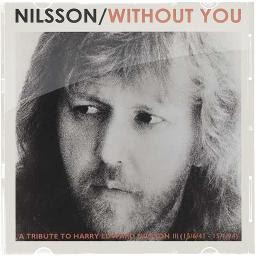
I’ve had many songs the past couple weeks on desperate families being separated at our borders. The one from last Friday was Mariah Carey’s We Belong Today. Before that others song were Thank God for Kids and also Foolish Games. Going back to the early 1970’s, here’s an emotional classic on that same theme. We’ve kidnapped these terrified kids from their parents with our nation now perceived as an abuser of human rights, & the Trump administration is now struggling mightily to reunite them. Some families may never be together again, which for them these lyrics of hopeless despair are all too real….
Recent Comments