

And the System is Rigged against Upward Mobility….Instead we have a system where capital is king over labor, the privileged are favored based on legacy wealth & educational advantages, large corporations are effectively strangling opportunities for smaller competitors & entrepreneurship (with financial barriers to entry also an enormous hindrance), & many workers can never get ahead no matter how hard they work. Much like the Gilded Age in the late 19th Century, America has largely evolved into a caste system where workers are mostly locked in place to their existing financial standing, as the system is rigged with wealth/wage gaps escalating & the existing economic growth is not shared by all. The once-renowned American Dream is now open only to the fortunate few. It’s why we need to shake up the system, but with something smart & workable, not Trump’s haphazard wrecking ball.
It’s mostly about Wages
Finding ways to reduce the cost of living would also serve the same basic purpose. But the system is rigged because workers keep falling behind when the pay can hardly cover the bills. Our target has been identified, here is the challenge for the economy we must endeavor to fix as posted here from wages-drop-despite-econom
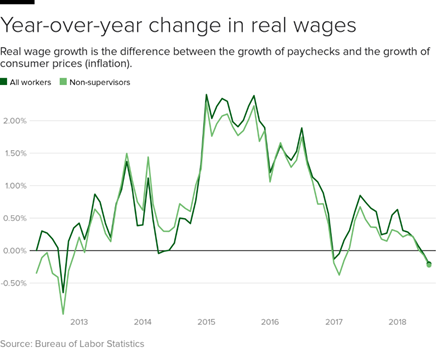
Wages in the U.S. fell over the past year despite an ongoing economic boom, according to data released by the Bureau of Labor Statistics on Friday. In the last 12 months through July, real average hourly earnings dropped 0.4 percent. That figure takes into account seasonal differences, as well as the effects of rising prices. An increase in the length of the average workweek was not enough to compensate for the fall, leaving average weekly earnings down 0.1 percent in the same period. Over the past month alone, real hourly wages were flat, while real weekly earnings dropped 0.2 percent. The sluggish advance in wages comes amid an economy that, by other measures, is booming. The economy grew at an annualized rate of 4.2 percent in the second quarter, and unemployment dipped below 4 percent in July. The dynamic could prove troublesome for Republicans hoping that a thriving economy will boost them in November’s midterm elections.
This trumpian phony claim of the greatest economy ever is projected to cool off soon: cbo-downgrades-economic-
Rising prices have erased U.S. workers’ meager wage gains, the latest sign strong economic growth has not translated into greater prosperity for the middle and working classes. Cost of living was up 2.9 percent from July 2017 to July 2018, the Labor Department reported Friday, an inflation rate that outstripped a 2.7 percent increase in wages over the same period. The average U.S. “real wage,” a federal measure of pay that takes inflation into account, fell to $10.76 an hour last month, 2 cents down from where it was a year ago. The stagnation in pay defies U.S. growth, which has increased in the past year and topped 4 percent in the second quarter of 2018 — the highest rate since mid-2014. The lack of wage growth has befuddled economists and policymakers, who hoped that after job openings hit record highs and the unemployment rate dipped to the lowest level in decades, employers would give beefy raises to attract and retain workers. But so far, gains have been slight, and small recent increases are being eclipsed by rising prices.
Inflation hit a six-year high this summer, in part because of a jump in energy costs. The price of a gallon of gas has increased 50 cents in the past year, up to a national average of $2.87, according to AAA. Some analysts expect the climb in energy prices to halt soon, which should bring the overall inflation rate down and possibly lift real wages slightly. Consumers are also paying more for housing, health care and automobile insurance, the federal government reported Friday. Additional price increases could be coming as President Trump’s new tariffs boost the prices of cheap imported products on which U.S. consumers rely. And many economists warn that growth might have peaked for this expansion. The combination of rising prices and stagnant wages poses a problem for Trump, who campaigned on promises of jobs and raises for the working-class Americans he called “the forgotten men and women of our country.” Delivering prosperity for those workers has proved difficult for Trump, as it was for Presidents Barack Obama and George W. Bush.
Thus far, however, most benefits of the strong economy appear to have gone to high-paid workers, stock market investors and corporations. The stock market hit record highs this year. Corporations, benefiting from a historic Republican cut to the corporate tax rate passed in December, have seen profits soar. Second-quarter earnings are up more than 20 percent over last year among companies that have reported so far, according to FactSet, a financial data tracker. Within the workforce, gains have been uneven, even as unemployment fell from a peak of 10 percent in October 2009 to the current 3.9 percent in July. Workers in the top 10th of the U.S. pay scale saw their wages jump 6.7 percent from 2009 to 2017, according to the left-leaning Economic Policy Institute. Workers in the bottom 10 percent saw a boost of 7.7 percent, largely the result of a slew of minimum-wage increases passed on the city and state level. But for those in the middle, wages have been flat or even slightly down. African American workers, male workers and people who graduated from high school but never completed college have had an especially hard time.
Workers as a whole are getting a smaller share of the gains than they did the past. In the last boom era of the late 1990s and early 2000s, labor was getting more than 82 percent of corporate-sector income, according to EPI. Today it is less than 77 percent. Some estimate that the frustration stretches back even further. Pew Research wrote in a report this week that, “despite some ups and downs over the past several decades, today’s real average wage has about the same purchasing power it did 40 years ago.” “We are nearly a decade into the recovery and we’re still arguing about whether or not we’re seeing meaningful gains in wages. That should be a given at this point in the cycle,” said Lindsey Piegza, the chief economist at Stifel, an investment firm. Numerous polls and surveys say Americans are more confident about the economy and their ability to get jobs, but many workers are wondering why their pay isn’t higher at a time when so much in the economy seems to be going well. There is no consensus explanation for why wage gains have not materialized.
Now that we’ve identified to such a large degree how the system is rigged, we need solutions before the economic system really goes haywire: Not-since-right-befor
For the third straight month, there were more job openings around than U.S. in July than there were unemployed workers. At the same time, hourly wages continue to grow at a tepid 2.7 percent and real income — when adjusted for inflation — is actually falling. What gives? After all, low unemployment is supposed to push wages up because employers face more competition for qualified workers, leading them to raise people’s pay. And while a healthy uptick in earnings is typically the last piece of the economic puzzle to fall into place, it just hasn’t materialized.
On paper, the U.S. economy has much going for it, and workers should be reaping the benefits. Unemployment is at an 18-year low, while the economic expansion that followed the financial crash is less than a year away from being the longest on record. Fiscal stimulus in the form of President Trump’s tax cuts and a boost in federal spending is driving growth. Corporate profits are gushing. But these tailwinds aren’t nearly enough to blow wage growth back on course given the deeper — and older — problems facing the economy. An analysis by the Economic Policy Institute finds that the textbook relationship between productivity gains — that is, how efficient workers are — and wages broke down way back in 1973. Since then, productivity has risen nearly 74 percent while real hourly pay has risen just 13 percent. That gap helps explain why corporate profits have soared while wealth inequality has worsened. Simply, workers are producing more but capturing less of the resulting profits.
No Cushion
These excerpts from savings-debt-few-american
The majority of Americans are not setting aside enough money in emergency savings to cover a significant unexpected expense, according to a new survey from CIT Bank. That’s a problem, because nearly half of American households were faced with emergency expenses in the past year. “More than one in four U.S. consumers do not save for unexpected events such as a home repair or health expense,” said Ravi Kumar, head of Internet Banking for CIT Bank in a press release. “Another quarter of consumers report saving less than 5 percent of their monthly household income for emergencies.” Experts generally recommended that your emergency fund be large enough to cover three to six months of your household expenses, but those numbers aren’t set in stone. If you have a job where your income is not stable, for example, or a health insurance plan with a high deductible, it might make sense to have an even larger cushion. But as numerous other studies have confirmed, the failure to save steadily has left a large majority of Americans far shy of those targets. Earlier this year, just 39 percent of respondents to a Bankrate.com survey said they had savings sufficient to to cover a $1,000 surprise expense. And that leaves people in a tough position when trouble arises. “Family and credit cards top the list of resources Americans rely on for financial support instead of utilizing a savings account for emergencies,” Kumar said.
Turn to Rubin
It’s always wise to read a Rubin op-ed in WaPo for perspective. Inside trumps-boasts-dont-matc
Jason Furman, chairman of the White House Council of Economic Advisers under President Barack Obama, wrote last month: “To explain the wage puzzle, we first need to define it. The central question is: Why are we not seeing the pace of wage growth we saw in the late 1990s? Like most respected economists, Furman finds that the root of slow wage growth is slowing productivity. “Productivity growth has slowed dramatically in recent years in the United States and almost all other advanced economies as well. Productivity growth was spectacular in the late 1990s, rising at 3 percent annually,” he writes. “It has been dismal in recent years, rising at only a 0.7 percent annual rate. That’s part of the explanation for slow wage growth: Based on the productivity numbers alone, one would predict that average wages would be growing about 2.3 percent more slowly than they did in the late 1990s.” Republicans talk only about tax cuts, which have very little to do with wage growth. (We’ve seen tax cuts used instead for stock buybacks and mergers.) They favor deregulation — but often deregulation that benefits the already rich and well-to-do. Furman recommends gradually raising interest rates and making sure that those at the lower end and on the middle of the economic ladder benefit “without harming productivity very much and in some cases even helping it.”
This is not about big or small government — big government is here to stay. It’s about good government that doesn’t perpetrate or exaggerate the advantages of those at the top. In short, President Trump’s brand of crony capitalism, protectionism and immigration exclusion makes for rotten economic policy, worsens inequality and does nothing for wage growth. There is plenty that can be done, if thoughtful people on the right and left can agree on a set of policies that help level the playing field to improve opportunity while spending in ways that will improve workers’ productivity. Unfortunately, whether it is tariffs or tax cuts or pushing dying industries, this administration embodies the worst aspect of the “captured economy.” Dumping Trump and Trumpism could clear the way for some bipartisan, constructive economic policy. That’s the hope, at any rate.
Inflation & Bankruptcy feeding the Fraud of an Economic System
It’s not surprising inflation is starting to ratchet up. Just from higher freight costs for every item carried by truck (like most every product we buy), the cost of living will likely be going up: cost-of-living-rises-at-qu
The titans of commerce have made capitalism an ideology instead of a tool. As such, its inhumanity and barbaric, intrinsic nature are on full display for those who choose to see it. Adherence to this economic system requires an uncanny ability to make excuses for the reality that very few Americans have partaken of the country’s growing wealth. Many people point out that under our economic system we built great skyscrapers, monuments, and more. But one must ask: what percentage of the population can take advantage or partake of the spoils? Most buildings, structures, and the like are off-limits to the vast majority of Americans, yet we praise their existence as some collective accomplishment. They are not. Like slaves, one builds them for the benefit of a few, as others are generally allowed entry just to serve. One must not forget the likes of the Toys ‘R Us saga. Its demise can be directly attributed to vultures that shuffled a few papers to extract capital from the company in exchange for saddled debt. In the end, 30,000 unemployed American citizens were the waste, the byproduct of a few amassing an inordinate amount of wealth from the transaction. Humanity was irrelevant.
Most financial companies make money not by investing in companies for the sole purpose of making money from the success of their products and services, but by merely moving paper and money around. Their investments produce nothing useful for society. They generate money off of the backs of others that have formed companies, others who have created products and services. I fail to see how this is substantially different from welfare recipients. Maybe welfare recipients should put on suits and ties as they use the system to get something for nothing. Oops—corporate welfare recipients already do that, and it works. Working-class welfare recipients: Are you listening? To be clear, most citizens on welfare are there because we do not have an economic system that rewards the real value of work. We reward capital more so than human labor. In other words, those with capital profit more than those who actually do the job to maintain that capital. But our indoctrination has taught us that those with capital are more valuable to society. Put a farmer on a deserted island alongside a stockbroker. If each is left to their own devices, who do you think would survive? Who is more valuable? The one with capital, or the one who can produce something? It is said that capitalism affords the efficient allocation of resources. That may be the case in theory. The reality is that capitalism has failed to do that, and instead allocated resources to the least deserving. For the economic system in the aggregate, it has allocated them stupidly. Why are we burning fossil fuels when the technology exists to go green en masse? Why are the most valuable workers who produce paid less than paper pushers? One could go on and on. Only when Americans understand the corrosive nature of our economy will they force a change. Only when they realize that the economic system isn’t divine, but human-made, will they engage to change the parameters and fix it in a manner that gives all equal access to success.
Health Care
For years the GOP has vowed on Obamacare they would repeal & replace with something better. It was a lie that proved politically expedient until they came into power, as they’ve now proven they never really had any better ideas to begin with. So we’re starting to see rising premiums & deductibles, coverage for preexisting conditions jeopardized, & raw deals for workers/contractors not on the plans of larger companies: premiums-for-employ
Having health insurance shields you from the full brunt of medical expenses, but it’s no guarantee that your costs will be low. Nevertheless, health-care bills still come as a surprise to many individuals who have insurance. Close to half of adults who bought their own coverage, along with 43 percent of those with insurance through their employer, said they were surprised by the high cost of their most recent health-care bill in the last year, according to a survey from Bankrate.com. The personal finance site polled 1,000 individuals in July. “For a lot of people who’ve had insurance for decades, there’s a creeping sensation that more cost is being thrown onto them,” said Taylor Tepper, an analyst for Bankrate.com.
Anticipating the Midterms
The midterms are sneaking up on us & once they’re concluded I’m very confident, Trump will be exposed as toxic for the GOP: republicans-midterm-elect
White Supremacist No-Shows
The big white nationalist/neo-Nazi rally scheduled for DC on the one-year anniversary of Charlottesville, well, fortunately, it was a big dud. But the anti-protesters fighting against the racism & bigotry were out in full force, as seen inside unite-the-right-2018-wa
A year ago, it seemed unfathomable: an American president defiantly defending “very fine people on both sides” of neo-Nazism; an American president suggesting moral equivalency between fighting for racial equality and championing white supremacy. More than a year-and-a half into the Trump presidency, many have accepted the reality that Trump is unlike any U.S. president previously seen, that he wallows in divisive rhetoric and tolerates odious behavior because he so often indulges in it. Indeed, his political career was built on betting the opposite. It effectively began with birtherism, blossomed with talk of Mexican rapists and Muslim terrorists, and flourished with allusions to gang-bangers spilling over the border. At a recent rally in Tampa, Florida, he fired up the crowd by ridiculing Democrats’ desire for “open borders, which equals massive crime.” They “want to let MS-13 rule our country,” he declared, adding, “Every day the brave men and women of ICE are liberating communities and towns from savage gangs like MS-13 that are occupying our country like another nation would.” There is no nobility in falling into Trump’s trap or in normalizing his ethnic animus. Although wallowing in bigotry might help Trump politically, it only diminishes us as individuals and as a people.
Another article on that same topic are in excerpts from study-white-americans-alt
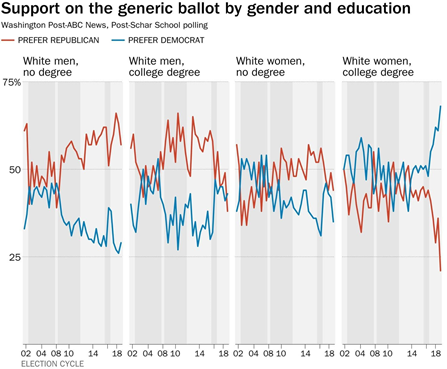
The alt-right is an extremely online-focused, extremely marginal movement. People who don’t closely follow the news or spend a lot of time online are unlikely to know a ton about the movement or self-identify with it, let alone spend time and money to attend its rallies. But while the alt-right as a practical political movement is marginal, Hawley’s research shows that its ideas are more popular than it might seem. Large numbers of people think the way that they do, and shape their political identity around a sense of white grievance and identity. They may not march around the streets yelling, “Jews will not replace us!” but they are extremely receptive to a politics that positions whites as victims and a growing minority population as an existential threat.
This kind of white identity politics has become more and more common in the mainstream conservative movement since Trump’s ascendancy. Just this week, Fox News host Laura Ingraham went on an anti-immigration rant that could just as easily been given by alt-right luminary Richard Spencer. Former Ku Klux Klan grand wizard David Duke even tweeted out his endorsement of Ingraham’s monologue. “The America we know and love doesn’t exist anymore,” Ingraham said during herWednesday night show. “Massive demographic changes have been foisted on the American people, and they are changes that none of us ever voted for, and most of us don’t like.” You can find similar rhetoric from Fox News host Tucker Carlson, whom the neo-Nazi website the Daily Stormer has referred to as “literally our greatest ally.” Rep. Steve King, a prominent anti-immigration Republican from Iowa, tweeted last year that “we can’t restore our civilization with somebody else’s babies”; the Daily Stormer has termed King “our guy.”
These mainstream figures are activating this latent alt-right constituency, bringing them into the conservative movement and the Republican Party as a core constituency. And nobody has done this more effectively than President Donald Trump: Study after study has shown that Trump’s primary and general election victories were driven by the racial resentment and demographic panic he activated among white voters. It matters that 11 million Americans have a worldview similar to the alt-right’s, and not because all of them will be marching with tiki torches on Sunday evening. It’s because many of them might show up at the ballot box in 2018, 2020, and beyond.
Honoring the Queen of Soul
A double-play here for your musical entertainment from a half-century ago. Since our president lies, this one seemed appropriate:
https://www.youtube.com/watch?
And her biggest hit, how about a little R-E-S-P-E-C-T for those professionals just doing their jobs, such as the ones serving the public in important roles inside the DOJ, FBI & media. Also some respect for working people putting in their time trying to make ends meet:
Recent Comments