
Wage Stagnation Continues Unabated….Trump was elected since he vowed to make America great again. He promised to help the forgotten working middle class who had been left behind. The prez has accomplished very little in that regard, but he does blow his own horn over the tax cuts. The problem is, that tax plan which he boasted was targeted to help working class families, the results are indicating otherwise. The only ones disproportionately benefiting are his corporate buddies, with the vast majority of the proceeds going towards executives of these large corporations, shareholders & purchasing stock buybacks: stock-buybacks-sec-r
Do not buy the hype the economy is doing so great. The same structural problems we’ve seen for decades haven’t been addressed. There’s plenty of proof wage stagnation still has its nasty grip over the workplace environment. The Trump tax cuts have put upward pressures on inflation, interest rates & deficits, but we still don’t see any corresponding increase in wages as these excerpts show from most-americans-wages-have
Earlier this month, the Labor Department revealed that America’s unemployment had fallen to its lowest level since 1969. President Trump proceeded to declare that he was now presiding over “the greatest economy in the HISTORY of America” — and a bitter debate over whether Trump had truly made the economy “great again.” This argument centered on two distinct questions:
1) Is the economy actually great?
2) To the extent that the economy is great, is said greatness a product of Trump’s wise leadership?
The second question is easier answer than the first. There is essentially no evidence that the president’s tax cuts (his sole piece of major economic legislation) did anything to significantly improve America’s macroeconomic performance. Since that legislation’s passage, economic growth in the U.S. has actually slowed; consumer spending and wage growth has been tepid; and business investment, unremarkable. One can reasonably credit Trump for successfully avoiding any policy mistake disastrous enough to derail the expansion he inherited (a preemptive war with North Korea, for example). But his entrance into the Oval Office did not coincide with any significant, positive change in the economy’s preexisting trend line. If you do not own a pass-through business or a significant amount of corporate stock, chances are Trump has personally done nothing to significantly improve your economic circumstances.
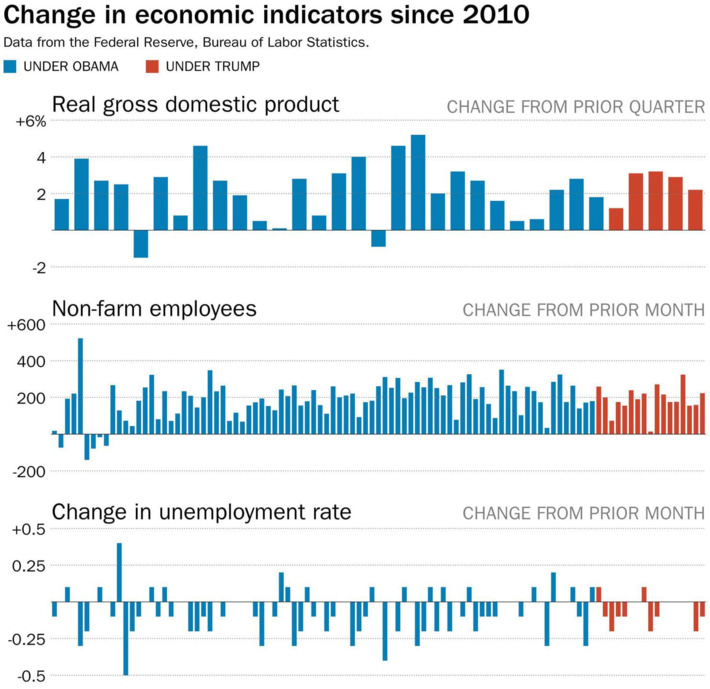
Whether the Trump economy has been “great” is a more subjective matter. By most measures, it is better now than when Trump took office; and by some, it is exceptionally strong. The overall unemployment rate is the lowest it’s been in decades; the African-American unemployment rate is the lowest in recorded history; and the ratio of job openings to unemployed workers is the lowest it’s been since the government starting tracking that statistic in December 2000. On the other hand, Americans are deeply indebted, many are stuck with part-time jobs, and wage gains have been so disappointing, their weakness has challenged fundamental premises of mainstream economics: Simply put, you aren’t supposed to be able to pay workers this little when the unemployment rate is this low.
And on Tuesday, the big picture on Americans’ paychecks grew even darker: In May, U.S. inflation accelerated to its fastest pace in more than six years — and wiped out what little wage growth the typical American worker had seen over the past 12 months in the process. The consumer price index was 2.8 percent higher this past pay May than it was the same month one year ago; that increase leaves real average hourly earnings for production and nonsupervisory workers (a.k.a. the vast majority of workers) 0.1 percent lower than they were 12 months ago. Notably, while wage growth was infamously tepid during the Obama years, the low-inflation environment of 2015 and 2016 did allow ordinary workers to secure real raises. Part of the uptick in inflation this year is a product of rising oil prices, a phenomenon over which the American president has little control. But some of it is likely attributable to the deficit expansion that Trump used to finance his regressive tax cuts. (To the extent that is the case, ordinary workers are effectively paying for the price for the Koch brothers’ big payday).
Regardless, the fact that workers aren’t seeing any real wage gains — at (somewhere near) the peak of an economic expansion — is a crisis. The share of growth that goes to labor (as opposed to capital) has declined substantially in recent decades. If workers can’t secure a bigger slice of the economic pie at a time of 3.8 percent unemployment, when can they? That is a genuinely hard question. But it seems reasonable to guess that Americans will not see truly significant wage gains, so long as their president continues to do everything in his power to reduce their leverage over their bosses.
More concrete signs of wage stagnation are in these excerpts from wages-down-for-workers-si
The federal government just admitted that workers are earning lower wages since the passage of the GOP tax cuts. When President Donald Trump was pushing Congress to pass his tax plan last year, which focused on lowering corporate rates and the income taxes of high earners, he pulled out a handy statistic: according to the president’s Council of Economic Advisers, the average family would make $4,000 more under the new plan. On Tuesday, the Bureau of Labor Statistics issued a new release detailing the “real earnings summary” through May 2018.
The true revelation was tucked away at the bottom of the release, in the “Production and nonsupervisory employees” section: “From May 2017 to May 2018, real average hourly earnings decreased 0.1 percent, seasonally adjusted,” it read. In today’s dollars, that’s a change from making an average of $22.62 per hour last May to making $22.59 per hour this May. The report continued, “The decrease in real average hourly earnings combined with a 0.6-percent increase in the average workweek resulted in a 0.5-percent increase in real average weekly earnings over this period.” In other words, people are working a few more hours a week, so they’re taking home more pay, but only marginally. The entire rationale behind the tax cut was to boost Americans’ wages. But the BLS numbers prove that workers who are not bosses and who produce things are in fact making less for their time than they did last year.
Averages tell only part of the story. The raises that high earners receive could represent a huge portion of any average wage growth increase, while low-income earners pull in less than they did before. Median earnings data would give a better picture of what most people are experiencing. Taking into account all employees — including bosses and non-production employees — the year-to-year change in real wages was flat from May 2017 to May 2018. Real average hourly earnings for both groups increased 0.1 percent from April 2018 to May 2018. In real terms, the average worker made $10.75 per hour in May and $10.74 per hour in April. According to Jared Bernstein of the Center on Budget and Policy Priorities, since Trump took office, the “real hourly pay of mid-class workers” is only up 0.4 percent, which amounts to “an extra dime an hour.” “At this rate, that tax-cut induced $4,000 in your paycheck will take 28 years,” Bernstein wrote.
Part of the reason wages are not rising is that inflation has now hit a six-year high, which eats into what workers earn. However, the main problem is that the largest focus of the tax cut plan was targeted at corporations and the wealthiest Americans. The people who run companies like AT&T, Wells Fargo, and Comcast began a public push, helped along by the White House and Republicans in Congress, to hype up the bonuses they were awarding to their workers — the clearest demonstration of “trickle-down” economics available. However, the total of those announced bonuses totaled roughly $981 million, while the cost of the tax bill was actually $1.4 trillion, meaning workers got only 0.9 percent, according to analysis by ThinkProgress.
Many of those business, including Walmart, touted the bonuses they were giving just as they were using their tax savings to offer stock buybacks to shareholders and to offset the cost of closing stores where thousands of people worked. In a USA Today op-ed titled, “That $4,000 raise Donald Trump and Paul Ryan promised you was a trickle-down lie,” venture capitalist and entrepreneur Nick Hanauer explained, “Businesses don’t give raises just because they got a tax cut.” And because the bonuses only happen once, workers won’t get more unless yearly wages rise — which they haven’t been, according to the federal government’s own data.
A summary of the uneven nature of the economy are seen in here: Why-many-Americans-aren’
Shortly before Christmas last year, President Trump announced that Republicans in Congress had finalized their proposed overhaul to the tax system. “Congress has reached an agreement on tax legislation that will deliver more jobs, higher wages and massive tax relief for American families and for American companies,” Trump said. He and his administration had been hammering on these benefits for weeks: Slashing corporate taxes would spur hiring and prompt businesses to increase wages and hiring. Sure, most of the benefit of the tax bill went to the wealthy and to corporations, but average Americans would see benefits, too — an increase of $4,000 to the average family income. Those claims were treated with justifiable skepticism at the time. (The average-income claim, for example, includes the gains seen by enormously wealthy households, which skews everything upward.) But on Tuesday, we got a reminder that those promises haven’t been realized in even small ways.
It’s true that wages have gone up, as Trump has repeatedly noted since the tax bill passed. But wages — or, to use the specific governmental metric, hourly earnings — have gone up steadily for years. The question is what those hourly earnings get you, the buying power. To assess that, the Bureau of Labor Statistics compiles the real average hourly earnings: the average hourly earnings divided by the consumer price index for urban consumers. In other words, it’s a measure of hourly wages as a function of inflation. On Tuesday, the BLS released a sobering report: Year-over-year, the real average hourly earnings number has dropped by 0.1 percent. After the recession, that figure has generally increased. Over the past year, though, it has been flat — despite the signing of that bill in December. The tax bill, which Trump promised would serve as “rocket fuel” for the economy, hasn’t led to any liftoff whatsoever in real average hourly earnings. Since December, the number hasn’t gone up; year over year, it hasn’t gone up.
There was a surge after Trump was elected, but after a peak in July, the figure has settled lower. Real average weekly earnings have increased year over year, albeit subtly. In May, the increase over April was a function of the number of hours worked increasing: The same hourly wage plus more hours means a higher weekly income. But that increase also has been essentially nothing since the passage of the tax bill. It’s worth noting, too, that Trump’s verbiage on wage increases hasn’t changed since the bill became law. In April, he bragged about how “wages for the first time are rising at the fastest pace in many, many years — 18, 19, 20 years.” Two weeks before he signed the bill, he said at a rally, “By the way, wages starting to go up. First time in 20 years, starting to go up.” Even to hear Trump tell it, the tax bill hasn’t done much.
The one great overriding economic problem in our modern society has been our failure to provide all Americans with equal opportunity. More details on the disappointing results from the tax cuts so far are posted here from That-tax-law-that-s-bankr
Most Americans have not been fooled by the GOP’s tax con, according to new polling from PPP. A majority, 51 percent believe it will mostly benefit the wealthy (true!) while just 30 percent say it will help middle class and only seven percent believe it will help the poor. But regardless of what they imagine the tax law will do, most of them have not felt any personal economic boost or even feel worse off since Trump took office. 26% say they’re worse off, and 37% say they’re in about the same place. That’s 63 percent who say they’re not better off economically than they were before Trump took office. Only 35 percent believe their economic situation has improved. One X factor appears to be whether one has stock investments. Among those who do [have stocks] 43% say they’re better off and just 16% worse off. But among those who don’t, only 27% say they’re better off to 35% who say they’re worse off. Anyway, most Americans don’t feel better off and most don’t think the GOP tax law is going to do anything to help middle- and working-class Americans.
Other Economic Problems
Here we see CBO estimates have proven more accurate than other partisan projections, so perhaps we should pay closer attention to their numbers when they tell us federal deficits are spiking: cbo-touts-its-project
America chose. Poorly. The Romney-Ryan defeat in 2012 killed the political viability of entitlement reform. Five years later, the CBO projected that without changes to stem runaway federal health care spending, major health care programs “would account for 40% of federal noninterest spending in 2047, compared with 28% today.” Last week, the trustees for Medicare and Social Security issued their annual report on the programs’ finances. They conclude that Medicare will be insolvent by 2026, three years sooner than last projected. That’s just eight Star Wars movies from now. The trustees projected that Social Security will reach insolvency in 2034,16 years from now. The program will begin dipping into its trust fund not in some distant future when our grandchildren are in charge, but this year — right now, on our watch.
It’s a similar story for the federal debt. In 2010, federal debt held by the public was 62% of GDP. At the end of 2017, it was 76.5% of GDP. This April, the CBO projected that it would reach 96.2% in 2028. Two days after the CBO made that projection, Ryan, whom the left-leaning Brookings Institution once admiringly called “the most daring budget hawk of his generation,” announced his retirement from Congress. As Romney and Ryan predicted, Medicare is headed for insolvency. They weren’t killing it. They were trying to save it from killing itself. It is still slowly killing itself, and Washington is doing nothing to save it. Because voters prefer politicians who tell them that no hard choices need ever be made, politicians tell voters that entitlements need never be touched. Republicans only six years ago made entitlement reform and the federal debt two of their core issues. They’ve since adopted the opposition’s position: Pretend the problem doesn’t exist.
Both parties sell voters a fantasy. The Republican fantasy was voiced last week by the Treasury secretary, who said economic growth will generate enough federal revenue to avoid any entitlement cuts or tax increases. The Democratic fantasy, voiced in reaction to Ryan’s proposals, is that the programs are fine and that all the talk of reform is an evil plot to hurt the poor and help the rich. In 2011, Democrats shouted that the Ryan plan would “end,” “kill,” and “terminate” Medicare. Politifact named that obviously false claim “Lie of the Year.” Ryan and Romney said if entitlements weren’t fixed, they would drive the federal debt to unsustainable levels. They were right. They lost. No one cared. Selling fantasies gets you elected. Telling the truth gets you nowhere.
That’s the lesson politicians have learned, so the new trustees report was all but ignored. Medicare will be insolvent in eight years, Social Security in 16, and the debt will soon surpass the size of the entire economy. The only politician daring enough to lead a fight to fix all of this is retiring at age 48. As the federal government rushes toward financial disaster, the president trades insults with NFL players and the opposition treats every presidential tweet as an existential threat to the republic. We delayed dealing with these crises in the hope that they would fall to some future suckers. But we’re the suckers. We believed the lies. All our delays bought us was a bigger crisis — one that’s just a few years away.
Inside this link the-economy-is-humming-so
Even with recent wage growth for the lowest-paid workers, there is still nowhere in the country where someone working a full-time minimum wage job could afford to rent a modest two-bedroom apartment, according to an annual report released Wednesday by the National Low Income Housing Coalition. Not even in Arkansas, the state with the cheapest housing in the country. One would need to earn $13.84 an hour — about $29,000 a year — to afford a two-bedroom apartment there. The minimum wage in Arkansas is $8.50 an hour. Even the $15 living wage championed by Democrats would not make a dent in the vast majority of states. “The housing crisis is growing, especially for the lowest-income workers,” said Diane Yentel, president of the National Low Income Housing Coalition. “The rents are far out of reach from what the average renter is earning.”
Nationally, one would have to earn $17.90 an hour to afford a modest one-bedroom apartment or $22.10 an hour for a two-bedroom rental. That’s based on the common budgeting standard of spending a maximum of 30 percent of income on housing. The report estimates that renters nationally make an average of $16.88 an hour. That means even those making above minimum wage struggle to afford rent. Housing costs have continued to rise with growing demand for rental housing in the decade since the Great Recession. At the same time, new rental construction has tilted toward the luxury market because of increasingly high development costs, the report said. The low-wage workforce is projected to grow over the next decade, particularly in service-sector jobs such as personal-care aides and food-preparation workers.
These excerpts from the-multiemployer-pension
Defined benefit pension plans have long been favored for retirement because they promise a guaranteed level of income and don’t require individuals to manage assets. It’s a painless way for retirees to enjoy their golden years. That is, unless the plan goes bust. Unfortunately, that’s the condition a number of pension plans are close to being in, particularly so-called “multi-employer” defined benefit plans. These plans typically cover unionized workers who move from job to job throughout their careers. It is no exaggeration to say that these plans face a crisis. There is currently a shortfall of more than $124 billion in these plans. Roughly 1,141 of these plans, covering 1.3 million workers, face more than $36 billion in shortfalls and are likely to start going bankrupt in as little as five years. One might think that employers in these plans could simply pay more to shore them up. Perhaps, but the amounts are so large that they could cause many employers to go into bankruptcy, with a snowballing effect on jobs and the economy. Not to mention, the government backstop for these plans – the Pension Benefit Guarantee Corporation (PBGC) – is itself predicted to go bust by 2025. So, we face a dilemma. We can let workers lose their retirement benefits, benefits they have been promised their whole careers would be there, look on as employers go broke and shut their doors, and perhaps see taxpayers called on to bail out the PBGC.
What could possibly be going on here with middle-aged women being so depressed: suicide-kate-spade-mental-heal
Getting back to politics, radical extremism has become our big problem: not-centrists-but-radicals-and
Democratic voters are more engaged in the 2018 midterm elections than Republican voters, according to a new George Washington University Politics poll. Forty-six percent of Democrats polled said they used social media to share an opinion, while 37 percent of Republicans said they do the same. Forty-two percent of Democrats said they had spoken to people about how to vote, while 33 percent of Republicans said they too had spoken with people on the subject.
America’s Human Rights Abuses Through Kidnapping Children
Seeing kids forcibly separated from their desperate families at the border should not be who we are. It’s simply more evidence the GOP corrupted by Trump has been given over to a mindset of deception & evil. America is even starting to be recognized as a human rights abuser, a title normally reserved for fascist regimes. At least evangelical leader turned Trump lackey, Franklin Graham, managed to muster up enough moral courage to criticize the separations. But since criticizing these deplorable staged kidnappings would essentially be calling out Trump policies, their newly-anointed omnipotent king, the evangelical community is largely mum on this. In hearing Sessions quoting scripture to justify this policy is repugnant: leave-the-bible-out-of-it-chil
To qualify for asylum, seekers must show that “they have a fear of persecution in their homeland based on their race, religion, nationality, political opinion or ‘membership in a particular social group,’ a catchall category that has in the past included victims of domestic violence and other abuse.” But no longer — Sessions has chosen to disregard basic humanity. Consider the case that the administration argued did not warrant asylum: “Monday’s ruling by Sessions centers on an asylum case filed by a Salvadoran woman who entered the United States illegally in 2014. She said she was escaping from an ex-husband who had physically and emotionally abused her for years, even after she moved elsewhere in El Salvador. The woman said that her ex-husband had raped her and that his brother, a police officer, had also threatened her.” How does that not merit asylum and protection?
In justifying the decision, Sessions pointed to a backlog of asylum cases, but it is far from clear that victims of domestic violence are resposible for the problem. Moreover, why not hire more immigration judges? Left-leaning groups blasted the decision. “We now are a country that is purposefully condemning countless thousands of women and children to violence and death,” said Frank Sharry, executive director of America’s Voice, in a written statement. He continued, “And for what reason? None of this keeps us safer, strengthens our economy or rebuilds our communities. None of this reflects the values we hold dear. None of this is true to the American creed. This is gratuitous cruelty. This is radical and extreme. This is evil.” People for the American Way excoriated the attorney general: “Jeff Sessions’ decision to make it harder of for thousands of individuals to escape violence, including sexual violence, is reprehensible. It’s yet another attack in Donald Trump’s war on immigrants in general and on the Latino community in particular.”
What was missing? Any complaints from the evangelical Christians who lecture us on “family values.” Absent were the pro-life forces who will go to the barricades for an unborn child. Hmm, I suppose their pro-life views don’t cover ripping kids from their parents’ arms or telling abused women to go back to their abusers. The GOP apparently has decided that aside from abortion, the only real “family value” is keeping out brown and black children, even at the cost of their lives. Next time a right-wing lawmaker or a pro-life advocate raises family values or protection of women, ask them why they are comfortable with the latest Sessions decision. We could use some elected officials with family values. And we could use a court challenge to Sessions’s ongoing crusade against vulnerable women and children.
Poor Side of Town
After decades of wage stagnation, thanks in part to our society’s inability & inattention to correct the damage, our nation has seen millions upon millions of middle-class working families now living on the poor side of town. There are numerous entire communities throughout the United States that are virtually dying out there!….

Recent Comments