
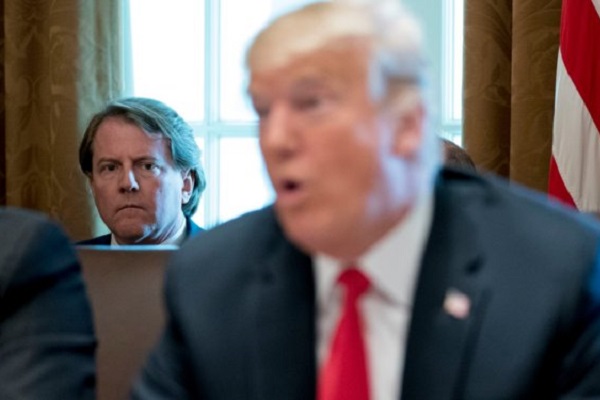
President Trump’s lawyers do not know just how much the White House counsel, Donald F. McGahn II, told the special counsel’s investigators during months of interviews, a lapse that has contributed to a growing recognition that an early strategy of full cooperation with the inquiry was a potentially damaging mistake. The president’s lawyers said on Sunday that they were confident that Mr. McGahn had said nothing injurious to the president during the 30 hours of interviews. But Mr. McGahn’s lawyer has offered only a limited accounting of what Mr. McGahn told the investigators, according to two people close to the president. That has prompted concern among Mr. Trump’s advisers that Mr. McGahn’s statements could help serve as a key component for a damning report by the special counsel, Robert S. Mueller III, which the Justice Department could send to Congress, according to two people familiar with the discussions.
Mr. Trump’s lawyers realized on Saturday that they had not been provided a full accounting after The New York Times published an article describing Mr. McGahn’s extensive cooperation with Mr. Mueller’s office. After Mr. McGahn was initially interviewed by the special counsel’s office in November, Mr. Trump’s lawyers never asked for a complete description of what Mr. McGahn had said, according to a person close to the president. Mr. McGahn, who as White House counsel is not the president’s personal lawyer, has repeatedly made clear to the president that his role is as a protector of the presidency, not of Mr. Trump personally. In its article, The Times said Mr. McGahn had shared detailed accounts about the episodes at the heart of the investigation into whether Mr. Trump obstructed justice in the Russia inquiry. Some of the episodes — like Mr. Trump’s attempt to fire Mr. Mueller last summer — would not have been revealed to investigators without Mr. McGahn’s help.
The article set off a scramble on Saturday among Mr. Trump’s lawyers and advisers. The president, sequestered at his private golf club in Bedminster, N.J., solicited opinions from a small group of advisers on the possible repercussions from the article. The president ordered Mr. Giuliani to tell reporters that the article was wrong, but Mr. Giuliani did not go that far in his television appearances. Mr. Trump was rattled by the Times report, according to people familiar with his thinking. The president, who is said to be obsessed with the role that John W. Dean, the White House counsel to President Richard M. Nixon, played as an informant during Watergate, was jolted by the notion that he did not know what Mr. McGahn had shared. Last fall, Mr. McGahn believed that he was being set up to be blamed for any wrongdoing by the president.
The White House counsel Donald McGahn sat down for at least three voluntary interviews with the special counsel Robert Mueller’s team and over 30 hours of questioning over the last nine months, The New York Times reported on Saturday. Mueller is investigating Russia’s interference in the 2016 presidential election and whether members of President Donald Trump’s campaign colluded with Moscow to tilt the race in his favor. He is also looking into whether Trump sought to obstruct justice in the Russia investigation at various points throughout the probe.
McGahn is a critical witness in the obstruction inquiry, given his knowledge of several key moments throughout the Russia investigation, including:
*Trump’s decision to fire then-FBI director James Comey
*Trump’s repeated efforts to force attorney general Jeff Sessions to oversee the Russia probe after he recused himself
*Trump’s reported attempts to fire Mueller
*Trump’s knowledge of former national security adviser Michael Flynn’s actions before his forced resignation
*Trump’s decision to draft a letter laying out his reasons for firing Comey the weekend before he was fired. The letter was never sent and is now in Mueller’s possession
White House attorney Don McGahn has been cooperating for several months with Robert Mueller’s investigation, according to a bombshell New York Times story that said he worried about becoming a scapegoat in the sweeping probe into possible collusion between Russia and Donald Trump’s presidential campaign. The Times wrote that McGahn, during 30 hours of interviews, is said to have shared details about “the president’s fury” about the special prosecutor’s probe, which also is looking into possible obstruction of justice by Trump. The Times cited “a dozen current and former White House officials” for its report, which was published on its site late Saturday. It said McGahn has had at least three voluntary interviews with investigators from Mueller’s team over the past nine months. The daily wrote that McGahn shared everything he knew with Mueller’s team, including “a sense of the president’s mind-set in the days leading to the firing of Mr. Comey; how the White House handled the firing of the former national security adviser, Michael T. Flynn; and how Mr. Trump repeatedly berated Mr. Sessions, tried to get him to assert control over the investigation and threatened to fire him.”
According to The Times, which cited “people close” to McGahn, the White House attorney was also worried that the president was setting him up “to take the blame for any possible illegal acts of obstruction.” He and his personal attorney William Burck “devised their own strategy to do as much as possible to cooperate with Mr. Mueller to demonstrate that Mr. McGahn did nothing wrong,” the newspaper reported. “Worried that Mr. Trump would ultimately blame him in the inquiry, Mr. McGahn told people he was determined to avoid the fate of the White House counsel for President Richard M. Nixon, John W. Dean, who pleaded guilty to conspiracy to obstruct justice in the Watergate scandal,” The Times wrote. “Mr. McGahn decided to fully cooperate with Mr. Mueller. It was, he believed, the only choice he had to protect himself.” Meanwhile, Trump appears to have been operating under the misconception that McGahn would act as his personal lawyer and represent his interests, when in fact, the role of the White House attorney is to represent the office of the US presidency — not any individual president. “The president wrongly believed that Mr. McGahn would act as a personal lawyer would for clients and solely defend his interests to investigators, according to a person with knowledge of his thinking,” The Times wrote in its report.
News that he had cooperated with Mueller’s probe reverberated throughout Washington this weekend, as much for the speculation of increased political and legal jeopardy that McGahn’s cooperation could put the president in, as well as for the titillating new details about dysfunction within Trump’s White House. The two men are reported to have a strained relationship. The mercurial president at times has so frustrated McGahn that he has taken to calling him “King Kong” behind his back, according to The Times, while Trump reportedly has frequently questioned McGahn’s loyalty. The daily added that McGahn’s lawyer said in a statement that his client had little choice but to cooperate with the Mueller probe and said that the president did not try to impede that cooperation. “President Trump, through counsel, declined to assert any privilege over Mr. McGahn’s testimony, so Mr. McGahn answered the special counsel team’s questions fulsomely and honestly, as any person interviewed by federal investigators must,” attorney William Burck said in his statement cited by The Times.
Rudy Giuliani, President Trump’s personal lawyer, coined a new Trumpism Sunday morning when he told Meet The Press‘ Chuck Todd that “truth isn’t truth.” His last-minute appearance followed a New York Times report that White House attorney Don McGahn has given some 30 hours of interviews in cooperation with Robert Mueller’s investigation into Russian interference in the 2016 election. When Todd implied that it was Trump’s team that was delaying negotiations with the investigation, Giuliani replied that it’s “silly” to think Trump should feel confident about testifying because “it’s somebody’s version of the truth, not the truth.” When Todd insisted that “truth is truth,” Giuliani replied, “No, it isn’t truth! Truth isn’t truth!”
That wasn’t even the only bombshell from the interview. Giuliani also admitted that the “original intention” of the infamous Trump Tower meeting in June of 2016 was to collect damaging information about Hillary Clinton. Though Trump himself recently admitted as much, this still directly contradicts what Trump originally said when he dictated a message on behalf of his son, claiming it was a meeting to discuss “the adoption of Russian children.” Giuliani even tried to claim that Donald Trump, Jr. and the other campaign officials who took that meeting didn’t even know that the woman they were meeting with, Natalia Veselnitskaya, was Russian. He also denied that she had any connections with the Russian government, even though she has represented the FSB, Russia’s spy agency, for nearly a decade and she even admitted this spring that she’s an informant.
Still, it was “truth isn’t truth” that was the big takeaway from the interview. Even as Giuliani said it, Todd joked, “This is going to become a bad meme.” During the panel discussion that followed, the Washington Post’s Eugene Robinson called it the new “Alternative Facts,” referring to an infamous line presidential adviser Kellyanne Conway used just days into the Trump administration to defend Trump’s distorted claims about how many people attended his inauguration. Moments after the interview aired in different markets across the country, Twitter was full of content mocking “Truth isn’t truth.”
Worse, he is signaling that others who speak out or may have vital information about the Russia investigation will face retaliation. He is, in plain sight, attempting to harass and muzzle witnesses. It’s an atrocious abuse of the president’s power and an assault on free speech. And not that Trump cares, but his peevishness is injuring the presidency. This tantrum is also extremely helpful to special counsel Robert S. Mueller III. Mueller is looking for evidence of Trump’s corrupt intent — evidence that his motives in firing Comey, attacking the attorney general and so on were for the purpose of derailing, if not ending, the Russia investigation. With every tweet and every retaliatory move, Trump hands Mueller another damning bit of evidence. One can imagine that, with regard to a possible obstruction of justice claim, Mueller hardly needs to talk to Trump at this point. He has a load of admissions already from Trump’s Twitter feed, which may be the best gauge of the president’s thoughts (unless one wants to count the NBC interview with Lester Holt confessing the Comey firing was about Russia, or the Wall Street Journal interview in which he confessed the security clearance rescissions are based on his anger over the Russia investigation). Trump would and still will say or do anything that could hinder an investigation into himself and his campaign. He seems incapable of understanding that his actions in trying to sabotage a legitimate investigation are in fact grounds for an obstruction claim, just as President Richard M. Nixon’s authorization for the CIA to squelch the FBI’s Watergate investigation was. Trump’s refusal to accept facts and legal concepts that impinge on his authoritarian impulses may in the long run be his undoing.
The federal investigation into whether Russia actively sought to help Donald J. Trump win the White House in 2016 has been hanging over his head since even before the election. As president, he has repeatedly criticized the special counsel inquiry and has questioned whether it is the best use of time and taxpayer funds. Some of the criticism has amounted to presidential opinion — like in calling James B. Comey “the worst F.B.I. director in history.” On Twitter alone, he has used the words “witch hunt” in over 100 posts. “That whole situation is a rigged witch hunt,” Mr. Trump told reporters on Friday at the White House. “It’s a totally rigged deal. They should be looking at the other side.” But hundreds of other statements, since Mr. Trump’s inauguration, included bold assertions about the Russia investigation that have demanded being fact checked. He hasn’t always been wrong. Mr. Trump’s estimates of the inquiry’s price tag, and his accusations of political bias as demonstrated in texts between F.B.I. officials, are among presidential claims that have passed the truth test. An analysis by The New York Times found more than 250 examples of exaggerated, misleading or flat-out false claims by Mr. Trump about the Russia investigation.
Omarosa reported having a stockpile of various evidence
Bad news for an already alarmed White House: Omarosa Manigault Newman has more than just secret audio tapes to release; she’s got a “treasure trove” of evidence she’s prepared to dribble out to torment President Donald Trump. A person with direct knowledge of her records told The Associated Press on Friday that the former Trump loyalist-turned-determined Trump foe has a stash of multimedia evidence – audio tapes, video, emails, text messages and other documentation – to support her claims in her tell-all book, “Unhinged,” about her brief time as a top aide in the Trump White House. Manigault Newman has made clear that she plans to continue selectively releasing the evidence if Trump and his associates continue to attack her credibility and challenge the claims in her book, published on Tuesday. She’s already dribbled out audio recordings of conversations, and video clips, texts or email could follow, according to the person who described what Manigault Newman has called a multimedia “treasure trove.” The person was not authorized to discuss the issue publicly and asked for anonymity.
“I will not be silenced. I will not be intimidated. I’m not going to be bullied by Donald Trump,” the fired Trump aide told the AP this week as she seemed to dismiss a threat from Trump’s campaign. She spoke to the AP hours after Trump’s campaign announced it was filing an arbitration action against her and her publisher, alleging she’d violated a signed agreement with the campaign that prohibits her from disclosing confidential information. On Wednesday, in an interview on MSNBC, Manigault Newman hinted she has more tapes and will make them public “when the time comes.” “Every time the Trump people challenge me, I’ll bring the receipts,” she said. She told PBS in a separate interview this week: “I have a significant amount, in fact, a treasure trove, of multimedia backup for everything that’s not only in “Unhinged,” but everything that I assert about Donald Trump.” And on Friday, The New York Times reported she may have as many as 200 secretly recorded tapes of conversations in the White House, citing unnamed White House aides worried about what she might release next as she continues her scorched-earth book promotion tour attacking Trump. She’s accused Trump of being racist and suffering from a mental decline.
Papadopoulos & Cohen on the Hot Seat
It looks as though Papadopoulos is about to serve jail time, since he was caught in numerous lies after not being forthright with investigators, as seen in george-papadopoulos-robert-
Federal authorities investigating whether President Trump’s former personal lawyer and fixer, Michael D. Cohen, committed bank and tax fraud have zeroed in on well over $20 million in loans obtained by taxi businesses that he and his family own, according to people familiar with the matter. Investigators are also examining whether Mr. Cohen violated campaign finance or other laws by helping to arrange financial deals to secure the silence of women who said they had affairs with Mr. Trump. The inquiry has entered the final stage and prosecutors are considering filing charges by the end of August, two of the people said. Any criminal charges against Mr. Cohen would deal a significant blow to the president. Mr. Cohen, 52, worked for the president’s company, the Trump Organization, for more than a decade. He was one of Mr. Trump’s most loyal and visible aides and called himself the president’s personal lawyer after Mr. Trump took office.
At this late stage of the inquiry, it is still possible that Mr. Cohen may plead guilty rather than face an indictment. He has hinted publicly and has stated explicitly in private that he is eager to tell prosecutors what he knows in exchange for leniency. A cooperation agreement would likely include a provision that Mr. Cohen also provide information to the special counsel, Robert S. Mueller III, who is investigating possible involvement by the Trump campaign in Russia’s meddling in the 2016 election. It is unclear whether the prosecutors and Mr. Cohen’s lawyers have had detailed discussions about a potential cooperation deal, but it is unlikely that the government would bring charges without having done so. But if a plea deal is not reached, either because Mr. Cohen and prosecutors cannot agree on the terms or because prosecutors determine he does not have valuable information or is not credible, the government would likely seek to bring charges well before the midterm elections. If the matter is not finalized by the end of August, prosecutors probably will wait until after the election, one of the people familiar with the inquiry said in recent weeks. That schedule would conform with the Justice Department’s informal policy of avoiding bringing politically sensitive cases that could influence voters close to an election.
Backlash from former Intelligence Officials
It sure looks as though Trump has really struck a nerve on these security clearance revocations: some-175-former-
It’s odd that Trump should bring up John Dean this weekend, for it was only this week that we also learned Trump has an Enemies List, just like Richard Nixon did. Unlike Nixon, though, the president is hiding nothing—using security clearances and his Twitter account as the chief weapons to go after his opponents. This is a dangerous move.
Today we live in a different world. Besides the fact that the president can count on a conservative media world to legitimize his activities, and a polarized electorate that insulates him from a Republican backlash, it no longer seems that the same kind of outrage exists. We are a nation so jaded by decades of scandal, and numbed by Trump’s endless violations of norms, that this story might be old news within a few days. The bar has been lowered so far under this president that revoking security clearances for partisan purposes could become another normalized part of Oval Office politics. For some Republicans, it could be a legitimate tool to go after the president’s critics in the bureaucracy.
But Americans need to remember the important lessons of Watergate. The reason that the revelation about Nixon’s list was so disturbing then—the fact that a president would be willing and able to use his power to create a climate of fear, smear opponents, and literally shut down his American citizens through ruthless action—remains just as important today. Right now, Trump is trying to create the same kind of toxic atmosphere that Nixon produced. His explicit goal is to silence opponents and to discredit them in the public eye. If this becomes acceptable, the next steps might be even worse.
Missile Defense
I fully supported what was referred to back then as Star Wars during the Reagan years. Even more so today I fully support making this investment as one of the most vital commitments we can make to keep our nation & the rest of the free world safe. This conclusion comes from the article bolster-american-
In the meantime, the United States should bolster its nuclear deterrent while also qualitatively improving U.S. missile defenses as the clock runs out until 2021. The Pentagon should follow through with its current plan to conduct research and development on the ground launched cruise missile. If deployed, this missile would violate the Intermediate Range Nuclear Forces Treaty. The Russians continue to violate it, so while American diplomats attempt to persuade the Russians to comply, it makes sense to develop the weapon if the agreement falls apart. Importantly, the United States must reject the notion that strategic stability is achieved by remaining vulnerable to Russian and Chinese nuclear weapons. In 2002, President George W. Bush withdrew the United States from the Anti-Ballistic Missile Treaty, but the United States has effectively remained tied to the spirit of that agreement. It has done so by deploying missile defenses designed to only defend against the kinds of missile threats from rogue nations like North Korea and by constantly reiterating to both the Russians and the Chinese that U.S. missile defenses are not meant to degrade their respective offensive forces.
But even if what those diplomats say is true, and it is regarding the spectrum of missile defense options today, making the argument has essentially conceded to the Russians and the Chinese that the United States ought not to defend against their offensive missiles. But the United States is not obligated as a matter of stability or moral responsibility to expose our allies or American citizens to nuclear attack. Decades after the Cold War, American technology has advanced such that the United States can deploy defenses that protect vulnerable U.S. assets that Russia and China can hold at risk. This would begin with rapidly deploying a sensor architecture in outer space that is necessary to track Russian and Chinese hypersonic missiles, and then to begin work on an interceptor layer also in outer space that would give the United States the ability to intercept enemy missiles in the boost phase. The Russians will oppose all of it but that is no reason not to do it. In various ways, the president and his officials have repeatedly said they wanted dominance over U.S. adversaries rather than parity. Whether or not the United States extends the New Start Treaty must fit into this larger context. The agreement is a mere tool in the hands of the government. If the Trump administration deems it useful to extend it, it can do it closer to its deadline. Until then, the United States should strengthen its nuclear deterrent and its missile defense architecture, and let the Russians prove it can, for once, consistently comply with an agreement.
Recent Comments